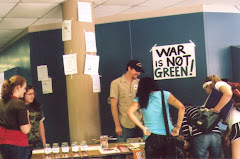
We're continuing with our tabling in the schools this semester. So far, we've staffed tables during lunch at Austin HS (on two dates), Lanier and Akins and were invited to table at career fairs at Crockett and Akins HS. We have a date scheduled for McCallum HS after Easter weekend.
Here's a favorite moment from the Crockett career fair: a student who realized she didn't know many of the figures on the peace wheel of fortune decided to take the info sheet and sat down to study it. After about 20 minutes of study, she came back and went around the whole wheel, telling us something about each peacemaker. She did it perfectly. Wow!
Monday, April 6, 2009


Monday, March 9, 2009
Vets explore the truth at Explore UT
.jpg)
.jpg)
.jpg)
This Saturday in Austin, the University of Texas held its annual open house called Explore UT. It's a great event that showcases university departments -- the arts, sciences, sports, music -- and draws families and bus-loads of high school students from all over Texas to get a look at the amazing facilities in our fair city.
However, the ROTC usually sponsors some kind of display directed to kids that doubles as a military recruitment tool. This year, it was a climbing wall and some chin-up bars. So, members of the UT student group, CAMEO (Campus Antiwar Movement to End Occupations) also had a table of literature next to the ROTC display and invited members of Iraq Veterans Against the War to join them to offer a reality check to kids drawn in by the military glamorization.
Reports from friends who were there indicated that the vets attracted a lot of interest from the kids, that teachers there with student groups encouraged their students to talk to the vets about the realities of war and that parents thanked the CAMEO group for bringing an alternative voice to the event.
Thanks to Heidi Turpin for the photos
Tuesday, March 3, 2009
Students use their own power to take on the powers that be
Here's an excellent article from the San Diego Union-Tribune about the recent success of students in the Education Not Arms Coalition in San Diego, who persuaded their school board to take away the shooting ranges in their high school JROTC programs.
Pellet guns to fall silent across school district
Student activists score bull's eye in bid to oust shooting programs
By Jennifer Vigil
STAFF WRITER San Diego Union-Tribune, February 28, 2009
SAN DIEGO — Hope is the political message of the moment, courtesy of President Barack Obama.
Tell that to Lincoln High School students Jennifer Astudillo, Sakeenah Shabazz and Alex Velarde, a trio of increasingly polished political activists.
Sakeenah, 16, said hope isn't part of her political equation.
“Always go in prepared for the worst, not with your hopes up,” she said.
What they've displayed instead is persistence, as they've led a group of high school students in persuading the San Diego Unified School District board to shelve campus air-rifle marksmanship programs.
The board confirmed the decision Tuesday, although members eased off a bit and allowed the programs to continue through the end of the school year. In the initial vote Feb. 10, they declared that such programs must cease immediately.
Jennifer, Sakeenah and Alex have attended that meeting and many others since last year, although they're only high school sophomores. Trying to get the attention of elected officials and political candidates has left them seasoned, despite their ages.
Some of the lessons they would like to share:
Keep a poker face, even if someone is taunting you. Strike back and that's the clip that makes the evening news.
Don't rely on your community representative. Your interests may not align.
Politics is always a blame game.
“I learned you cannot necessarily depend on people in power,” said Alex, 15, who took a trip to Sacramento last year to talk to legislators about the state budget. “They just place the blame. It was like, 'Can you please give us an answer – what are you going to do?' ” The teens are part of a group called the Education Not Arms Coalition, which opposes marksmanship programs because its members believe allowing students any access to guns on campuses contradicts zero-tolerance policies.
The group, which has recruited students from other high schools and middle schools, also believes that allowing the programs to persist shows an insensitivity to students who have seen three peers – from Lincoln, Point Loma and Mission Bay high schools – killed in street shootings over the past two months.
Xavier McGregor, a sophomore at Lincoln High, told the board Tuesday that “the simple symbol” of guns on campus is too much for him to take.
The cause has drawn criticism from Junior ROTC supporters, who have accused opponents of trying not just to eliminate marksmanship but the entire program because of its military affiliation.
Alex, a former ROTC member, said that's not the goal. Yet he; Jennifer, 16; and Sakeenah believe San Diego high schools log more visits from military recruiters than college recruiters. Changing that may be their next campaign.
The sophomores credit one of their teachers, Eduardo Ochoa, with guiding them as they pushed to end the marksmanship program. He's their “receptionist, chauffeur, teacher, friend,” Alex said.
Sakeenah quickly added, “Educator, therapist.” Ochoa, who taught the three during a freshman social-justice class, said he has stepped out of the way as they put their lessons into practice – picking a cause, creating a plan and building constituencies. He said their poise comes from their experiences, not his instruction.
“They're working,” Ochoa said. “They're part of the democratic process.”
Pellet guns to fall silent across school district
Student activists score bull's eye in bid to oust shooting programs
By Jennifer Vigil
STAFF WRITER San Diego Union-Tribune, February 28, 2009
SAN DIEGO — Hope is the political message of the moment, courtesy of President Barack Obama.
Tell that to Lincoln High School students Jennifer Astudillo, Sakeenah Shabazz and Alex Velarde, a trio of increasingly polished political activists.
Sakeenah, 16, said hope isn't part of her political equation.
“Always go in prepared for the worst, not with your hopes up,” she said.
What they've displayed instead is persistence, as they've led a group of high school students in persuading the San Diego Unified School District board to shelve campus air-rifle marksmanship programs.
The board confirmed the decision Tuesday, although members eased off a bit and allowed the programs to continue through the end of the school year. In the initial vote Feb. 10, they declared that such programs must cease immediately.
Jennifer, Sakeenah and Alex have attended that meeting and many others since last year, although they're only high school sophomores. Trying to get the attention of elected officials and political candidates has left them seasoned, despite their ages.
Some of the lessons they would like to share:
Keep a poker face, even if someone is taunting you. Strike back and that's the clip that makes the evening news.
Don't rely on your community representative. Your interests may not align.
Politics is always a blame game.
“I learned you cannot necessarily depend on people in power,” said Alex, 15, who took a trip to Sacramento last year to talk to legislators about the state budget. “They just place the blame. It was like, 'Can you please give us an answer – what are you going to do?' ” The teens are part of a group called the Education Not Arms Coalition, which opposes marksmanship programs because its members believe allowing students any access to guns on campuses contradicts zero-tolerance policies.
The group, which has recruited students from other high schools and middle schools, also believes that allowing the programs to persist shows an insensitivity to students who have seen three peers – from Lincoln, Point Loma and Mission Bay high schools – killed in street shootings over the past two months.
Xavier McGregor, a sophomore at Lincoln High, told the board Tuesday that “the simple symbol” of guns on campus is too much for him to take.
The cause has drawn criticism from Junior ROTC supporters, who have accused opponents of trying not just to eliminate marksmanship but the entire program because of its military affiliation.
Alex, a former ROTC member, said that's not the goal. Yet he; Jennifer, 16; and Sakeenah believe San Diego high schools log more visits from military recruiters than college recruiters. Changing that may be their next campaign.
The sophomores credit one of their teachers, Eduardo Ochoa, with guiding them as they pushed to end the marksmanship program. He's their “receptionist, chauffeur, teacher, friend,” Alex said.
Sakeenah quickly added, “Educator, therapist.” Ochoa, who taught the three during a freshman social-justice class, said he has stepped out of the way as they put their lessons into practice – picking a cause, creating a plan and building constituencies. He said their poise comes from their experiences, not his instruction.
“They're working,” Ochoa said. “They're part of the democratic process.”
Thursday, February 26, 2009
San Diego school board does the right thing: bans shooting ranges in schools

This was great news from the Education Not Arms Coalition in San Diego. At a historic school board meeting of the San Diego Unified School District held earlier this month, students, veterans, parents and other coalition supporters persuaded board members to end the practice of using shooting ranges in the JROTC programs in San Diego high schools. The board decision marked the culmination of a campaign begun by the Education Not Arms Coalition in 2007. Here's their report:
February 10, 2009 - San Diego Unified, located in the middle of one of the largest military complexes in the world, took the uncharacteristic step of banning rifle training conducted under the military's high school JROTC program. Eleven schools with rifle ranges were affected in the nation's eighth largest urban district.
Before the board meeting began, speakers representing local high schools and colleges addressed an outside crowd of 200 students, parents, teachers and community supporters. Some high schools sent so many students that two charter buses, courtesy of the AFSC, were used for transportation. Anticipating a long evening before the school board would discuss the rifle training issue, the Association of Raza Educators provided tamales to help sustain the crowd.
It wasn't until four hours into the board meeting, at 9:00 PM, that the agenda item came up for discussion. The vote was preceded by testimony from about 15 pro- and con- speakers in front of a crowd that was largely in favor of terminating the weapons training program. One school board member said that in all of his many years on the board, this was the most impressive student effort he had ever seen. Even two board members who opposed the resolution expressed their admiration for the students' involvement. When the decision was made, the resolution, which immediately banned all marksmanship training in the district, passed by a vote of 3-2. The crowd then spilled out of the auditorium to hold a loud and joyous celebration.
This achievement was made possible by a collaboration of students and various community groups who first came together in 2007 as the Education Not Arms Coalition. One of their main concerns was the way schools were tracking students into military training (via JROTC) while denying them adequate class alternatives, especially ones needed to qualify for college. Students from African American and Latino families were being disproportionately affected.
To address the problem, the coalition adopted three initial goals--convince the school district to:
-stop placing students into military science (JROTC) classes without their informed consent.
-stop telling parents and students that the class will help them qualify for college, when it won't.
-ban weapons training and JROTC gun ranges in San Diego schools.
All three goals have now been achieved, the first two by a superintendent's directive, the third by school board action. Throughout the over one-year long campaign, high school students have played a central role in educating and mobilizing their peers, with support from a variety of community and college groups.
Audio of the entire Feb. 10 hearing and school board decision is posted on the SD Unified site: http://www.sandi.net/indices/board.htm. Video should be added soon.
Before the board meeting began, speakers representing local high schools and colleges addressed an outside crowd of 200 students, parents, teachers and community supporters. Some high schools sent so many students that two charter buses, courtesy of the AFSC, were used for transportation. Anticipating a long evening before the school board would discuss the rifle training issue, the Association of Raza Educators provided tamales to help sustain the crowd.
It wasn't until four hours into the board meeting, at 9:00 PM, that the agenda item came up for discussion. The vote was preceded by testimony from about 15 pro- and con- speakers in front of a crowd that was largely in favor of terminating the weapons training program. One school board member said that in all of his many years on the board, this was the most impressive student effort he had ever seen. Even two board members who opposed the resolution expressed their admiration for the students' involvement. When the decision was made, the resolution, which immediately banned all marksmanship training in the district, passed by a vote of 3-2. The crowd then spilled out of the auditorium to hold a loud and joyous celebration.
This achievement was made possible by a collaboration of students and various community groups who first came together in 2007 as the Education Not Arms Coalition. One of their main concerns was the way schools were tracking students into military training (via JROTC) while denying them adequate class alternatives, especially ones needed to qualify for college. Students from African American and Latino families were being disproportionately affected.
To address the problem, the coalition adopted three initial goals--convince the school district to:
-stop placing students into military science (JROTC) classes without their informed consent.
-stop telling parents and students that the class will help them qualify for college, when it won't.
-ban weapons training and JROTC gun ranges in San Diego schools.
All three goals have now been achieved, the first two by a superintendent's directive, the third by school board action. Throughout the over one-year long campaign, high school students have played a central role in educating and mobilizing their peers, with support from a variety of community and college groups.
Audio of the entire Feb. 10 hearing and school board decision is posted on the SD Unified site: http://www.sandi.net/indices/board.htm. Video should be added soon.
-- photo from the Education Not Arms site
Thursday, February 19, 2009
earth to mall: War is Not a Game
Check out this article posted today on Common Dreams:
Wake Up Call: Activists visit "The Army Experience"
by Elaine Brower
Here's how it begins:
On Monday, February 16th about 50 activists decided to take a trip to the Franklin Mills Mall right outside Philadelphia, PA to get their look at a new "store". "The Army Experience" (AEC), as it is called, built by the taxpayers to the tune of $12 million, attracts local kids to play video games, most of which are high tech simulations of combat situations.
The group was made up of members from all over the area. World Can't Wait from New York City and Philadelphia; Delaware Valley Veterans of America; Iraq Veterans Against the War (IVAW); Veterans for Peace from the Philadelphia area; CodePink Women for Peace; Granny Peace Brigade; and, the Brandywine Peace Center converged on the mall at about 10:30 AM, greeted by a heavier than usual security force.
Read the full article to find out how the activists did a "freeze" action at the store while wearing t-shirts that read "War is Not a Game."
Wake Up Call: Activists visit "The Army Experience"
by Elaine Brower
Here's how it begins:
On Monday, February 16th about 50 activists decided to take a trip to the Franklin Mills Mall right outside Philadelphia, PA to get their look at a new "store". "The Army Experience" (AEC), as it is called, built by the taxpayers to the tune of $12 million, attracts local kids to play video games, most of which are high tech simulations of combat situations.
The group was made up of members from all over the area. World Can't Wait from New York City and Philadelphia; Delaware Valley Veterans of America; Iraq Veterans Against the War (IVAW); Veterans for Peace from the Philadelphia area; CodePink Women for Peace; Granny Peace Brigade; and, the Brandywine Peace Center converged on the mall at about 10:30 AM, greeted by a heavier than usual security force.
Read the full article to find out how the activists did a "freeze" action at the store while wearing t-shirts that read "War is Not a Game."
Wednesday, February 18, 2009
Press release from the National Priorities Project:New data about US Army recruits
As the U.S. Military begins offering citizenship for service to fill its ranks ...
The National Priorities Project releases a new report:
Recruitment 2008: Age, Race, Income, Education
National Priorities Project (NPP) finds a drop in age among new recruits, an over representation of low- and middle-income individuals,an increase in Black recruits and a decrease in Hispanic recruits
Online Tool Allows the Public to Analyze Army Databy State, County, Zip Code, Education Level, "Quality of Recruit"
NORTHAMPTON, MA – A new NPP analysis notes a significant drop in age among new recruits. Using census material, combined with data on 2008 Army enlistment obtained through a Freedom of Information Act, NPP research also uncovers a continued over representation of recruits from low- and middle-income families, an increase in Black recruits, decrease in Hispanic recruits and important education trends.
This work is a result of an expanded NPP initiative, which now includes a database of 2004-2008 military recruitment numbers broken down by zip code, county and state. A snapshot analysis and overview of current military recruitment data, which includes a ranking of counties by recruits per thousand youth, charts and tables on a particular county, zip code or state is available at http://www.nationalpriorities.org/.
"The education trends are striking," notes Suzanne Smith, Research Director for National Priorities Project. "While both Hispanic and Black recruits are more likely to have a high school diploma than whites, as a group they have lower AFQT scores. This finding makes us question their opportunities as enlisted personnel."
NPP's new data shows:
· Low- and middle income neighborhoods continue to be overrepresented. Active-duty Army recruits disproportionately come from low-to middle income neighborhoods. Neighborhood incomes in the lowest 10% of population were underrepresented, as were those in the top 20%.
· The age of new recruits fell. Fifty-two percent of new recruits in 2008 were below the age of 21. This is up from 48.5% in 2007.
· The percentage of recruits who are black has risen since 2005, increasing from 15% in 2005 to 16.6% in 2008. The sharpest increase was between 2007 and 2008.
· The percentage of new recruits who are Hispanic has fallen a full percentage point between 2005 and 2008, with 10.85% of new recruits identifying themselves as Hispanic.
· Both Hispanic and Black recruits are also more likely than whites to be women, and to come from low-income neighborhoods.
· Both Hispanic and Black recruits are more likely to have a high school diploma, but as a group have lower scores on the AFQT than white recruits.
Jo Comerford, NPP's Executive Director adds, "Even more striking than the finding that 52% of new recruits are below the age of 21 is the fact that 82.2% of new recruits are 24 or under. Once again we are compelled to note the Army's disproportionate reliance on young people, people of color and individuals from low- and middle-income families to fill its ranks. And this on the heels of the recent decision to recruit immigrants with temporary visas, offering them a fast-track to citizenship in exchange for service – because the Army still cannot meet its ever-expandng quotas."
# # #
The National Priorities Project (NPP) is a 501(c)(3) research organization that analyzes and clarifies federal data so that people can understand and influence how their tax dollars are spent. Located in Northampton, MA, since 1983, NPP focuses on the impact of federal spending and other policies at the national, state, congressional district and local levels. For more information, go to http://www.nationalpriorities.org/sites/all/modules/civicrm/extern/url.php?u=173058&qid=183708.
The National Priorities Project releases a new report:
Recruitment 2008: Age, Race, Income, Education
National Priorities Project (NPP) finds a drop in age among new recruits, an over representation of low- and middle-income individuals,an increase in Black recruits and a decrease in Hispanic recruits
Online Tool Allows the Public to Analyze Army Databy State, County, Zip Code, Education Level, "Quality of Recruit"
NORTHAMPTON, MA – A new NPP analysis notes a significant drop in age among new recruits. Using census material, combined with data on 2008 Army enlistment obtained through a Freedom of Information Act, NPP research also uncovers a continued over representation of recruits from low- and middle-income families, an increase in Black recruits, decrease in Hispanic recruits and important education trends.
This work is a result of an expanded NPP initiative, which now includes a database of 2004-2008 military recruitment numbers broken down by zip code, county and state. A snapshot analysis and overview of current military recruitment data, which includes a ranking of counties by recruits per thousand youth, charts and tables on a particular county, zip code or state is available at http://www.nationalpriorities.org/.
"The education trends are striking," notes Suzanne Smith, Research Director for National Priorities Project. "While both Hispanic and Black recruits are more likely to have a high school diploma than whites, as a group they have lower AFQT scores. This finding makes us question their opportunities as enlisted personnel."
NPP's new data shows:
· Low- and middle income neighborhoods continue to be overrepresented. Active-duty Army recruits disproportionately come from low-to middle income neighborhoods. Neighborhood incomes in the lowest 10% of population were underrepresented, as were those in the top 20%.
· The age of new recruits fell. Fifty-two percent of new recruits in 2008 were below the age of 21. This is up from 48.5% in 2007.
· The percentage of recruits who are black has risen since 2005, increasing from 15% in 2005 to 16.6% in 2008. The sharpest increase was between 2007 and 2008.
· The percentage of new recruits who are Hispanic has fallen a full percentage point between 2005 and 2008, with 10.85% of new recruits identifying themselves as Hispanic.
· Both Hispanic and Black recruits are also more likely than whites to be women, and to come from low-income neighborhoods.
· Both Hispanic and Black recruits are more likely to have a high school diploma, but as a group have lower scores on the AFQT than white recruits.
Jo Comerford, NPP's Executive Director adds, "Even more striking than the finding that 52% of new recruits are below the age of 21 is the fact that 82.2% of new recruits are 24 or under. Once again we are compelled to note the Army's disproportionate reliance on young people, people of color and individuals from low- and middle-income families to fill its ranks. And this on the heels of the recent decision to recruit immigrants with temporary visas, offering them a fast-track to citizenship in exchange for service – because the Army still cannot meet its ever-expandng quotas."
# # #
The National Priorities Project (NPP) is a 501(c)(3) research organization that analyzes and clarifies federal data so that people can understand and influence how their tax dollars are spent. Located in Northampton, MA, since 1983, NPP focuses on the impact of federal spending and other policies at the national, state, congressional district and local levels. For more information, go to http://www.nationalpriorities.org/sites/all/modules/civicrm/extern/url.php?u=173058&qid=183708.
Monday, February 9, 2009
Our table today at Lanier High School
We've begun our spring semester literature tabling in the high schools. We've had good student interest at the tables. We staffed a table during lunch at Austin HS recently and today did one at Lanier HS and another at Akins HS. Here is a report on our experience at Lanier:
We double-booked today by mistake, but it's a good sign when there are enough of us to be at two schools on the same day. Thanks go out to Veterans for Peace, Dick Underhill and George Taylor (who happens to be visiting Austin this month) for joining me at Lanier HS. Hart and Spencer planned to table at Akins HS and we should hear back about that soon.
We had a good day at Lanier. They have two lunches on Mondays separated by about an hour between (nice chance to visit with co-tablers). Student interest was quite good. Almost every time someone stopped by the table, that drew others. The peace wheel was at Akins, so we did a penny poll. We were struck again by how much students were concerned about health care. 51 students did the poll, and here is the breakdown of the penny poll results:
Health Care -- 40% of pennies
Education -- 24%
Environment -- 16%
Military -- 10%
International Humanitarian Aid -- 10%
Quite a few took one look at the categories and chucked all their pennies into the health care jar. One student explained, "If you don't have health, you can't do anything else." One student put all her pennies into the military jar because she said she has family in the military. Most kids thought pretty carefully about how to distribute the pennies and were surprised when they saw the fliers showing how taxes are really spent. We could almost see the light bulbs going on about why there never seems to be money enough left over from war-making to give people proper health care. Something is messed up when young people have to even worry about health care.
We had a new batch of "I think for myself" buttons that were well-liked. We gave away almost all 50 that I had brought.
A group of about 3 young women students came by to tell us that they are part of a student group at Lanier that is planning a Day Without Violence event on April 4. They aren't sure yet what they will do, but they wanted to invite us and took a couple of fliers with our contact info.
We also invited kids to fill in the posters that say "I'd rather buy [blank] than war." Several wrote in "shoes." One wrote "shoes and dog." Another wrote "a million kittens and a car." Then she added "Green." I asked what she meant and she said "like green plants."
A number of women students wore peace signs on necklaces or clothing. It's great to see it back in vogue!
We double-booked today by mistake, but it's a good sign when there are enough of us to be at two schools on the same day. Thanks go out to Veterans for Peace, Dick Underhill and George Taylor (who happens to be visiting Austin this month) for joining me at Lanier HS. Hart and Spencer planned to table at Akins HS and we should hear back about that soon.
We had a good day at Lanier. They have two lunches on Mondays separated by about an hour between (nice chance to visit with co-tablers). Student interest was quite good. Almost every time someone stopped by the table, that drew others. The peace wheel was at Akins, so we did a penny poll. We were struck again by how much students were concerned about health care. 51 students did the poll, and here is the breakdown of the penny poll results:
Health Care -- 40% of pennies
Education -- 24%
Environment -- 16%
Military -- 10%
International Humanitarian Aid -- 10%
Quite a few took one look at the categories and chucked all their pennies into the health care jar. One student explained, "If you don't have health, you can't do anything else." One student put all her pennies into the military jar because she said she has family in the military. Most kids thought pretty carefully about how to distribute the pennies and were surprised when they saw the fliers showing how taxes are really spent. We could almost see the light bulbs going on about why there never seems to be money enough left over from war-making to give people proper health care. Something is messed up when young people have to even worry about health care.
We had a new batch of "I think for myself" buttons that were well-liked. We gave away almost all 50 that I had brought.
A group of about 3 young women students came by to tell us that they are part of a student group at Lanier that is planning a Day Without Violence event on April 4. They aren't sure yet what they will do, but they wanted to invite us and took a couple of fliers with our contact info.
We also invited kids to fill in the posters that say "I'd rather buy [blank] than war." Several wrote in "shoes." One wrote "shoes and dog." Another wrote "a million kittens and a car." Then she added "Green." I asked what she meant and she said "like green plants."
A number of women students wore peace signs on necklaces or clothing. It's great to see it back in vogue!
Subscribe to:
Posts (Atom)