Showing posts with label Education. Show all posts
Tuesday, May 23, 2023
Tuesday, September 29, 2020
Truth in Recruitment carries on during Covid
Excellent article posted today in Antiwar.com by Kate Connell and Fred Nadis about the work of Truth in Recruitment, a group like SOY in Santa Barbara, CA:
Counter-Recruitment in the Time of Covid
In 2016-17, the U.S. Army visited Santa Maria High School and nearby Pioneer Valley High School in California over 80 times. The Marines visited Ernest Righetti High School in Santa Maria over 60 times that year. One Santa Maria alumnus commented, “It’s as if they, the recruiters, are on staff.” A parent of a high school student at Pioneer Valley commented, "I consider recruiters on campus talking to 14 year olds as "grooming" young people to be more open to recruitment in their senior year. I want my daughter to have more access to college recruiters and for our schools to promote peace and nonviolent solutions to conflict."
This is a sample of what high schools, particularly in rural areas, experience nationwide, and the difficulty of confronting the presence of military recruiters on campus. While our nonprofit counter-recruitment group, Truth in Recruitment, based in Santa Barbara, California, views such military access as beyond excessive, as far as the military is concerned, now that the pandemic has closed campuses, those were the good old days. The Air Force’s Recruiting Service Commander, Maj. Gen. Edward Thomas Jr., commented to a journalist at Military.com, that the Covid-19 pandemic and high school shutdowns nationwide have made recruiting more difficult than previously.
Thomas stated that in-person recruiting at high schools was the highest yield way to recruit teenagers. “Studies that we’ve done show that, with face-to-face recruiting, when somebody is actually able to talk to a living, breathing, sharp Air Force [noncommissioned officer] out there, we can convert what we call leads to recruits at about an 8:1 ratio,” he said. “When we do this virtually and digitally, it’s about a 30:1 ratio.” With closed recruiting stations, no sporting events to sponsor or appear at, no hallways to walk, no coaches and teachers to groom, no high schools to show up at with trailers loaded with militarized video games, recruiters have shifted to social media to find likely students.
Yet the school shutdowns, combined with the economic uncertainty during the pandemic, have only made vulnerable populations more likely to enlist. The military also is aware of this. An AP reporter noted in June that in periods of high unemployment, the military becomes a more enticing option to teens from impoverished families.
This is apparent from our work. Truth in Recruitment has been working to reduce recruiter access to students in Santa Maria high schools where the demographics on some campuses are 85% Latinx students, many from immigrant farmworkers working in the fields. Nevertheless, the Santa Maria Joint Union High School District (SMJUHSD) was pleased to report in June 2020 that sixty students from all the area high schools had decided to enlist.
As a group dedicated to regulating the presence of military recruiters on campuses, and their access to students’ private information, we are seeing the consequences of both the pandemic and recruiters’ aggressive social media campaigns. Under the No Child Left Behind Act (NCLBA) of 2001, high schools that receive federal funds must allow recruiters to have the same access to students as employers and colleges. This law is often cited when school districts say that they cannot regulate recruiter access to their students and schools. But the key word in the law, which shows what is possible, is the word "same." As long as school policies apply the same regulations to all types of recruiters, districts can implement policies that regulate recruiter access. Many school districts across the country have passed policies regulating recruiter access, including Austin, Texas, Oakland, California, the San Diego Unified School District, and the Santa Barbara Unified School District, where Truth in Recruitment is based.
According to federal law, while districts are required to provide student names, addresses, and parents’ phone number, families have the right to "opt out" to prevent schools from releasing to the military further information about their children. However, now that teens have their own phones, recruiters have direct access to them – following them on social media, texting and emailing them privately – and have access to their friends in the process. Because of this, parental oversight is circumvented and a family’s privacy rights are ignored. Recruiters not only gain access to student’s through their phones, but through ‘surveys’ and sign up sheets, where they ask questions such as "citizenship status?" and other confidential information.
Recruiters online tactics can be dubious. For one example, The Nation reported that on July 15, 2020,the Army’s Esports team on Twitch advertised a fake giveaway foran Xbox Elite Series 2 controller, valued at more than $200.When clicked, animated giveaway advertisementsin the Army’s Twitch stream chat boxes led users to a recruiting web form with no mention of any giveaway.
Recent events reveal that building our military forces does not strengthen our country’s security. The COVID-19 pandemic has shown that the biggest threats to our nation cannot be stopped with military methods. It has also shown the risks that troops face from working and living close together, making them vulnerable to this deadly disease. In WW1, more troops died from disease than in combat.
The police killings of unarmed black people have also shown the ineffectiveness of force to ensure the safety of our communities. A young black woman on the news testified that she had considered joining the police force but changed her mind after seeing the systemic abuse of police departments, both in the killing of George Floyd and the way police brutalized peaceful protesters. Even more pointedly, the death of US Army SPC Vanessa Guillen, murdered by a fellow soldier at Ford Hood in Texas, after first being sexually harassed by an officer, indicates the unstated dangers that recruits can face.
How can those of us who are opposed to the current militarization of society in general and high schools in particular curtail the military’s push to meet recruitment "quotas?"
Step by step.
Because of the pandemic, TIR has had to adjust strategies and procedures; after winning the right, with help from the ACLU So Cal affiliate, in 2019 to table at high school events in Santa Maria – we are now faced with school closures. So instead, we have been conducting meetings, events and presentations remotely, utilizing services like Zoom. In fall of 2020, we met with the SMJUHSD and the new Superintendent in Santa Maria to establish a working relationship and so progress in our goals.
Throughout the pandemic, Truth in Recruitment has given online presentations to students and local community groups. The focus has been on the stakes of military careers and our campaign to regulate recruiters’ access to students. On social media, we have regularly posted about military recruiting tactics – in order to give students a more balanced view of what life in the military can mean and to recognize that they can choose nonmilitary career options. The presence of military recruiters on high schools does not serve an educational purpose. Our goal is to build student and family awareness so they can make educated choices about their future.
Kate Connell is the director of Truth in Recruitment and the parent of two students who attended Santa Barbara schools. She is a member of the Religious Society of Friends, Quakers. Along with parents, students, veterans, and other community members, she successfully led the effort to implement a policy regulating recruiters in the Santa Barbara Unified School District.
Fred Nadis is an author and editor based in Santa Barbara, who volunteers as a grant writer for Truth in Recruitment.
Truth in Recruitment (TIR) is a project of the Santa Barbara Friends (Quaker) Meeting, a 501(c)3 nonprofit. TIR’s goal is to educate students, families, and school districts about alternatives to military careers, inform families of their children’s privacy rights, and advocate for policies regulating recruiter presence on campuses.
Tuesday, August 4, 2020
A law clinic at Akins HS and the award -winning Internship leader who initiated it
I heard this story on The Texas Standard today -- what a great program! Kudos to the law clinic students, to Armin Salek who initiated the clinic and to Dan Rather for awarding Mr. Salek the "best idea to innovate Texas education" award!
Nation’s First High School Law Clinic Nurtures Fledgling Legal Eagles
The sounds of Texas.
By Joy DiazAugust 4, 2020 12:53 pmArts & Culture, Crime & Justice, Education, Sounds of Texas

The Rather Foundation
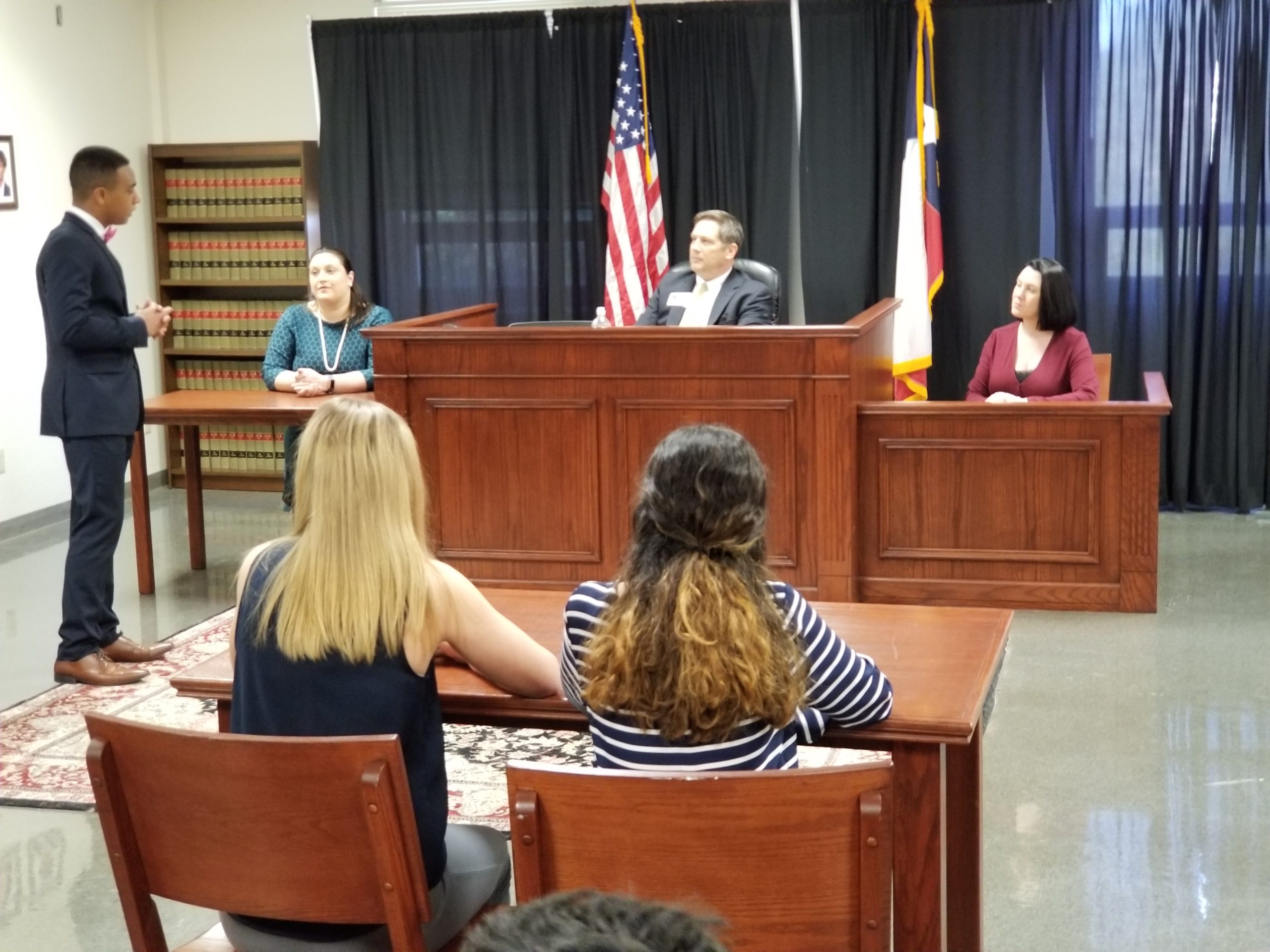
Devin Ritter, a junior at Akins High School in Austin, presents his opening statement to Texas Supreme Court Justice Jeffrey Boyd as attorneys and students observe.
When he was in law
school, Armin Salek noticed that most of his friends’ parents were also
attorneys. That didn’t make for a very diverse pool of people entering the
legal profession. To jump-start an interest in the law among young people who
hadn’t been exposed to that career path, Salek created the Legal Eagle
Internship at Austin’s Akins High School. It is the first high school legal aid
clinic in the country. Salek was awarded the 2020 Rather Prize, which recognizes of “the best idea to innovate
Texas education.” He plans to use the $10,000 he received to start more legal
clinics.
“We have the first cohort of high school students working on real,
legal cases – immigration, wills. Our students were particularly excited about
handling gender marker and name changes at the end of the year. … Through that
clinic, students at our school would be able to tell students who have not
identified with their name or gender marker that we support you, and we will
help you get the name identification that matches the way you see yourself.”
“What we are trying to do is create a pipeline for
underrepresented populations into the [legal] profession. Law should be a place
to advocate, regardless of where you start.”
“I really learned family
law through my students. They can tell you when a child can provide their
opinion for which parent they want to live with in a family law court. They’ll
tell you about situations where they were in immigration court, watching a
parent in deportation proceedings.”

Tuesday, July 7, 2020
American Youthworks now enrolling: conservation and green building programs
I've been hearing radio spots on NPR this week that American Youthworks is enrolling students for its programs. These are good opportunities for learning skills and doing creative, helpful work in areas of conservation and green building. American Youthworks operates Youthbuild and Texas Conservation Corps, which are Americorps programs that include skills training, living wages, health care and education awards toward college. These are sustainable options for youth! Check them out at www.americanyouthworks.org
Saturday, December 28, 2019
Education, Not Militarization, a video from Project YANO
A video from Project YANO -- Youth and Non-military Opportunities -- featuring high school students in California facing aggressive recruiting in their schools and discussing their own plans for their futures.
Saturday, November 9, 2019
Teaching Environmental Justice -- a workshop in Austin by Rethinking Schools
Good news from the folks at Rethinking Schools:
Breakfast and lunch are provided.
Teaching Climate Change and Environmental Justice
Thursday, November 21University of Texas Austin College of Education
Dear Texas Rethinking Schools friends,
We are happy to announce that while in Austin for the National Council for the Social Studies annual conference, Rethinking Schools editor Bill Bigelow will offer a free full-day workshop on teaching about climate change and environmental justice on Thursday, Nov. 21, 2019 at the University of Texas Austin College of Education.
Sign up here.
We are happy to announce that while in Austin for the National Council for the Social Studies annual conference, Rethinking Schools editor Bill Bigelow will offer a free full-day workshop on teaching about climate change and environmental justice on Thursday, Nov. 21, 2019 at the University of Texas Austin College of Education.
Sign up here.
Bigelow will introduce lessons from the Rethinking Schools book he co-edited, A People’s Curriculum for the Earth: Teaching Climate Change and the Environmental Crisis . Each participant will receive a free copy of the book.
Event Details
University of Texas Austin College of Education
Thursday, Nov. 21, 2019
8:30am to 3:30pm
Ideal for in-service and pre-service teachers, other school staff, curriculum coordinators, teacher educators, school media specialists, and environmental justice activists.
Breakfast and lunch are provided.
Sponsored by the Texas Center for Education Policy, UT Austin College of Education, Environment Texas, and Rethinking Schools.
Meet the Teaching People’s History Team at NCSS 2019
And if you are going to the National Council for the Social Studies in Austin, Nov. 22-24, visit the Zinn Education Project booth in the exhibit hall, and attend workshops led by Rethinking Schools editors, Adam Sanchez, Ursula Wolfe-Rocca, and Bill Bigelow.
More details here.
More details here.
Thursday, November 7, 2019
Being Bilingual is a Superpower!

This is true! If you grow up speaking and understanding two or more languages, please hang onto them. This will be a lifelong advantage in any career -- and in life in general!
Wednesday, May 8, 2019
ACC adds second bachelor's degree program
A growing number of students in Austin are graduating high school with not only a high school diploma but an associate's degree as well. These are students who have completed an Early College program while they were in high school. Here is news from ACC that they are accepting students with associate's degrees for a new bachelor's degree program in Computer Information Technology -- a high demand field in Austin.
From the Community Impact Newspaper:
"In the fall 2018 semester, Austin Community College launched its first bachelor’s degree program, seeking to address the nursing shortage in Central Texas by allowing local registered nurses to complete a bachelor’s degree in nursing.
Next year, the community college district will begin its second bachelor’s degree program with a similar goal——helping members of the local workforce advance their careers——albeit in a different sector of the local economy.
The Bachelor of Applied Science program in Computer Information Technology will have three specializations when the program begins at ACC in the spring semester of 2020: software development, cybersecurity and data science. ACC’s board of trustees approved the program unanimously May 6.
Mike Midgley, the vice president of instruction at ACC, said the community college identified the information technology sector as an important area to expand its academic offerings.
“We think (IT professional development) is the most important thing to do next after health sciences, given our regional economy,” Midgley said."
Wednesday, March 27, 2019
First time to table at Texas State University
Big thanks to Greg Moses for inviting us to be part of a tabling day at Texas State University in San Marcos today! Hart and I were so glad to be joined by GI resister, Stephen Funk (and his adorable dog, Crisco) and by Mia Estrada from the Philosophy Department at TX State. And thanks to Alan Pogue for coming and taking photos! We value all the engagement with students who stopped at the table to talk about the issues addressed by the reflection question, the Peace Wheel and the Penny Poll.
Penny Poll results showed a strong priority for Education, garnering a full 30% of the penny vote, followed by 23% for the Environment, 21% for Health Care, 11% for Humanitarian Aid, 10% for the Military and 5% for NASA. Several students put all their pennies into the Education jar, and a student made the apt observation that if we didn't have catastrophes caused by climate change, we wouldn't need so much humanitarian aid.
Thanks, Bobcats, for welcoming us to your campus today!
Penny Poll results showed a strong priority for Education, garnering a full 30% of the penny vote, followed by 23% for the Environment, 21% for Health Care, 11% for Humanitarian Aid, 10% for the Military and 5% for NASA. Several students put all their pennies into the Education jar, and a student made the apt observation that if we didn't have catastrophes caused by climate change, we wouldn't need so much humanitarian aid.
Thanks, Bobcats, for welcoming us to your campus today!
| Mia models our t-shirt! |
| Stephen's sign with our guest dog, Crisco |
| A few of the responses to our reflection question |
Friday, September 14, 2018
Reminder: AISD policy limiting student access by military recruiters in our schools
A reminder to all students, teachers, administrators and parents within the Austin Independent School District: AISD has a policy of protecting student privacy by placing these restrictions on military recruiters who visit AISD campuses. This is the policy as adopted by the AISD School Board. Any violations should be reported to the school's Principal.
GKC (Local) Policy for Recruiters on Campus:
The following guidelines shall apply to recruiters on
District campuses:
1. All recruiters shall first report to the campus main
office to obtain a visitor’s badge each time they visit school property.
2. The principal shall designate specific areas on each
campus for recruiting purposes. Recruiting may not occur at school athletic
events or other school-sponsored events, unless specifically authorized by the
principal.
3. Recruiters shall not continue ongoing contact when a
student makes it clear by speech or other conduct that contact with the
recruiter is unwelcome. In no event may recruiters meet with a student under
the age of 18 years off campus without written consent submitted to a campus
administrator by the student’s parent or guardian.
4. Evidence of a parent’s or guardian’s intent to provide
directory information upon request shall be respected. [See FL] (This refers to the form that parents and guardians fill out for their students that can opt them out of allowing their contact information to be given to military recruiters)
5. The Armed Services Vocational Aptitude Battery (ASVAB) test
shall be administered according to the same terms and conditions as other
aptitude tests administered within the District. District schools shall select “Option
8” on the ASVAB test prior to the administration of the ASVAB at the school to
ensure consistency with the opt-out provisions for release of contact
information to the military.
6. Recruiting of any kind shall not be permitted at a time,
place, and manner that disrupts classroom instruction. Recruiting in a
classroom or other designated space shall be acceptable if it is at the
invitation of authorized school personnel and part of a school-approved
program.
7. Schools shall allow information regarding recruiting,
including recruiting by the military and those advocating alternatives to the
military, to be made available to students in an equivalent manner and
location.
8. Recruiters shall not solicit student contact information
directly from a student or require such information as a condition to
participate in an activity or to receive an award or gift.
If a visitor fails to comply with the general rules or
guidelines set out in this policy, the principal or other campus administrator
may deny the visitor access to the campus in accordance with law. If a military
recruiter fails to comply with the guidelines set out in this policy, the
principal or other campus administrator may contact the military recruiter's
supervisor to report the failure to comply and request that such individual not
return to the campus.
Tuesday, August 7, 2018
The best way to protect students from violence
Quote of the day -- from an article in today's issue of the Austin American-Statesman about recommendations made by the Texas Senate Select Committee on Violence in Schools and School Security:
"The best way to protect students from violence is to prevent youth from considering violence as a solution to their problems in the first place." -- Stephanie Rubin, CEO of Texans Care for Children
Thursday, March 15, 2018
Books, Not Bullets -- students walk out and speak out
![]() |
| photo by Carolyn Kaster, AP |
PARKLAND,
Fla. — They solemnly spilled onto the high school football field, holding signs
protesting gun violence and wearing shirts that read "March for our
lives." They waved at a crowd of onlookers who had gathered to show
support.
Exactly
one month after 17 people were killed at Marjory Stoneman Douglas High School in
Parkland, survivors of the massacre joined tens of thousands of students across
the U.S. by walking out of school on Wednesday morning.
The
mass protests were held at 10 a.m. local time in each time zone and lasted 17 minutes, one for each of the Parkland
victims. Organizers said the purpose was to highlight "Congress’ inaction
against the gun violence plaguing our schools and neighborhoods."
An estimated 185,000 people in 50 states were expected
to join the walkout, with around 3,100 schools planning to
participate, an organizer with the Women's March told NBC News.
The
marches ranged in size. At Terre Haute North Vigo High School in Terre Haute,
Indiana, organizer Elisabeth Downing said over 60 students stood in silence,
many wearing orange — the color representing support for tighter gun laws.
"No
matter what you decide the action to be, we just want action," said
Downing, a senior. "We’re tired of thoughts and prayers, and we’re ready
to finally do something."
In
Rhode Island, where a nor'easter on Tuesday dumped up to a foot
of snow in some places, students weren't able to march outside. About 250
students at Pilgrim High School in Warwick instead walked from their classrooms
to the auditorium.
"That
could have been us. We were the same age as the Parkland kids," said a
co-organizer, Karly Evans, a senior. "It was a very emotionally moving
experience to be part of."
Emily
Lower, a senior from Central High School in St. Joseph, Missouri, said a few
hundred students showed up to the walkout — "way better than we
expected."
“I
couldn’t wipe the smile off my face," she said. "To see that many
kids engaged and what their voices could accomplish and seeing the masses, it
was an incredible feeling."
At
Columbine High School in Littleton, Colorado, the walkout lasted 30 minutes —
17 minutes for the Parkland victims, and 13 for each victim of the massacre at
the high school in 1999. During the half-hour of silence, students released
red, white or blue balloons, one at a time, in memory of those killed.
In
New York, some protesters gathered outside Trump Tower, including Cinthia
Sierra, a 16-year-old from the Leadership and Public Service High School in
downtown Manhattan.
"It
literally can happen to any school, anywhere in the country. School should be a
place that's safe. It felt like we're all using the voices that we have,"
she said.
Not
every school was supportive of people leaving class. In Clayton, Missouri,
students were warned they would be given detentions for walking out — but they
came out in the hundreds anyway.
In
Washington, a crowd in the thousands gathered, holding signs toward the White
House reading "Books Not Bullets" and "Fire Politicians, Not
Guns."
At
the stroke of 10 a.m., the crowd sat down en masse, their backs to the White
House, and then stayed silent for 17 minutes. Afterward, some marched to
Capitol Hill to meet with legislators.
Sen.
Elizabeth Warren of Massachusetts was among a handful of Democratic lawmakers
to greet student speakers.
"The
NRA has held Congress hostage for so many years now," Warren told MSNBC.
"These young people are here to set us free."
In
Parkland, the crowd cheered as students exited the high school and gathered in
the center of the football field. Some onlookers yelled "We love
you!" to the students.
Harrison
Sanclemente, 42, of Parkland, held up a white sign with black letters saying
"Support our kids."
"All
they’re asking for is safety. It should be a no-brainer,” he said.
After
the walkout, a 17-minute prayer service was held at a local park.
Anahelena
Natera brought her 9-year-old daughter, Ella, who knows Stoneman Douglas
students from her drama camp, where many are counselors.
Natera
said she sees the student-counselors "as friends and I see them as role
models — and what role models to have. They're amazing."
Heather
Taylor, 15, a freshman at Stoneman Douglas who was in the building during the
shooting, said Wednesday that she was glad the community had been galvanized by
the tragedy.
"I
just hope we can get better gun control. I hope that happens," she said.
"I hope people see we’re really trying and we’re not going to stop."
Kalhan
Rosenblatt reported from Parkland, and Elizabeth Chuck, Ethan Sacks and
Jonathan Sperling from New York.
The hashtags #NationalSchoolWalkout and #Enough for Wednesday's
protest and gun reform have thousands of tags on Instagram, with users
uploading by the minute.
![]() |
| photo by Andrew Harnik, AP |
Subscribe to:
Posts (Atom)