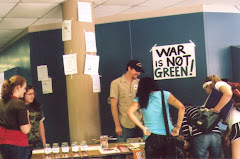
Today, Hart, Craig and I did our first Nonmilitary Options table of the new school year. We were at McCallum HS in north central Austin. I had invited Allan Campbell, host of the "People United" radio program on KO-OP radio to join us there to interview us and students who came by the table because he is doing a show about us this coming Friday, Oct. 2. But, unfortunately, just as Allan started taping some student reactions, the McCallum Principal came over and said that he couldn't do it without official permission from the district. I'm not sure what that process is, but hopefully we can try this again sometime. Meanwhile, Hart is scheduled to be part of Allan's program this Friday, Oct. 2 from 1 pm to 2 pm at 91.7 FM.
At our table, we had our peace wheel, penny poll and usual materials, including the yellow "It's My Life!" books that now have a new CD included that has a good list of post-high school options in Texas. The books with the new CDs were just shipped free to us by the AFSC office in Chicago.
They have made CD's for about 10 states, including Texas, where military recruiting is highest. I gave a copy of the book and CD to the school librarian, who showed particular interest (she said her daughter is doing an AMERICORPS program in New Orleans). We gave away about 6 more books, as well as buttons, "Arlington West" videos and "Addicted to War" books to students as prizes for the peace wheel.
I changed out the people on the peace wheel slightly, adding Michael Franti (musician who coined "you can bomb the world to pieces, but you can't bomb it into peace") and Wangari Maathai (Kenyan Nobel Prize laureate for tree-planting). No one was familiar with Ms. Maathai, but hopefully, they learned. Hart did the penny poll -- not sure yet of results. I had made a new banner, showing a large peace sign in the shape of a tree, that read "Peace is Green" and "Peace is Creative" -- trying to emphasize the environmental connection. We have a new "WAR IS NOT GREEN" flier, too.
It was "twin day" at McCallum, so some students were dressed alike in pairs.
I especially enjoyed seeing a young man and woman walking together with awesome, matching Mohawks.
We had two teachers and a couple of parents come by and like our stuff.
Student interest was good. Some remembered us from last spring and came by to do the peace wheel and penny poll again. No flak from the police this time about our buttons (showing a gun with its barrel tied in a knot).
There is an Amnesty International student group at McCallum, and their faculty sponsor was one of the teachers who stopped by. He said maybe he could interest them in bringing us in as guest speakers and showing the film, " The Cost of War." I had a DVD with me and gave it to him. It's a really good film with interviews of vets from around the state, including Iraq war veteran and GI resister, Mark Wilkerson.
Upcoming tabling dates:
Monday, Oct. 12 -- Garza HS
Friday, Oct. 16 -- Lanier HS
Monday, Oct. 26 -- Akins HS
Here's the list of peacemakers on our peace wheel this fall. Study up!
Peace Heroes and Sheroes
defending freedom through creative nonviolence
Gator is an award-winning slam poet and emcee in Austin who was president of his class at Reagan High School. He has been active with the Texas Youth Word Collective and the band, Public Offender, whose latest CD, Drop Jewels, is a call to men to stop violence against women.
Wangari Maathai won the Nobel Peace Prize in 2004 for leading the Green Belt Movement in Kenya, a tree-planting effort undertaken mostly by women’s groups. Maathai earned a doctorate degree and has written and spoken extensively about conservation and human rights.
Martin Luther King, Jr. (1929 – 1968) is perhaps the best known of all US Civil Rights leaders. Following methods used by Gandhi and the freedom movement in India, King’s oratory, writings and personal example directed the movement in using nonviolent strategies such as mass marches, boycotts, sit-ins and direct negotiations in achieving equal rights.
John Lennon (1940 – 1980) was a member of the British rock band, The Beatles, and also had a successful solo career. He and his spouse, Yoko Ono were outspoken peace advocates who expressed their views through music and performance art.
Michael Franti is a musician, composer and poet. He produces an annual POWER TO THE PEACEFUL music festival and tours with his band, Spearhead. He combines different forms of music like hip hop, jazz and reggae and is well-known for his lyric, “you can bomb the world to pieces, but you can’t bomb it into peace.”
Cesar Chavez (1927 – 1993) led worker strikes, boycotts and marches for higher wages and better working conditions for agricultural workers in the US, including South Texas. He and Dolores Huerta co-founded the United Farm Workers, led the successful California grape boycott and helped organize other labor organizations in Texas and the Midwest. A statue of Chavez stands on the UT campus.
Julia Butterfly Hill is a poet, speaker and environmental activist who lived for two years on a platform 18 stories high in a 1,000 year-old redwood tree in California as a protest against clear-cutting. Her book about that experience, The Legacy of Luna, was published in 2000.
Flobots is a rock/hip-hop band based in Denver. Their lyrics promote nonviolent social change. Their current release is Fight With Tools.
Mohandas Gandhi (1869 – 1948) was one of the most influential nonviolent activists in history. He helped lead India to independence from British Colonial Rule and his nonviolent methods inspired MLK and others in the US Civil Rights Movement.
Helen Keller (1880 –1968) was the first deafblind person to graduate from college. She learned to speak and became a world traveler and author who was outspoken in her advocacy for peace, women’s voting rights and labor rights.
Barbara Jordan (1936 – 1996) was an attorney who, in 1966, became the first African- American woman voted into the Texas Senate and, in 1972, the first black woman from a southern state voted into the US House of Representatives. She later taught at the LBJ School for Public Affairs in Austin. In April 2009, a statue of Barbara Jordan (the first statue of a woman on campus) was installed at UT.
Monday, September 28, 2009


Friday, August 21, 2009
New website exposing US military violence against women
There's a new website up and running as of this week, produced by a team from California State University at San Marcos, where a proposal for a ROTC program was recently shelved as a result of well-organized opposition on campus.
The website deals with the issue of violence against women within the military.
Here is the team's objective, as posted on their home page:
This blog is part of a collaborative project designed to deepen and broaden understandings of the relationships between U.S. militarism, foreign policy, imperialism, racism, sexism, and violence against girls and women.
See the site here.
The website deals with the issue of violence against women within the military.
Here is the team's objective, as posted on their home page:
This blog is part of a collaborative project designed to deepen and broaden understandings of the relationships between U.S. militarism, foreign policy, imperialism, racism, sexism, and violence against girls and women.
See the site here.
Tuesday, August 11, 2009
The dilemma of draft registration for men age 18 - 26
Great article about draft registration, posted today on Common Dreams and originally published in Yes! Magazine:
Registering for Peace
by Tobin Jacobrown
On Wednesday, the 29th of July, I filed a lawsuit against the federal government declaring that, because of my religious beliefs, I should not be required to register for the draft unless it could be officially recognized that I claim to object to all war.
I grew up believing not only in nonviolence, but also that I should never submit myself to a system that is contrary to my beliefs. As traditional principles of Quakerism, these were part of my religious education; but also, by Quaker teaching, a person must come to these conclusions only by checking their own conscience.
There was no time that my beliefs were challenged as deeply as when I first had to decide whether or not to register.
I had just come back from six months working with Burmese refugees in Thailand when I was delivered a letter threatening prosecution if I didn't sign a draft registration card, already inscribed with my name and address. Having just lived on the edge of a war-zone, my beliefs were as clear as ever before.
On the other hand, refusing to register for the draft is a felony and, though no one has been convicted in two decades, it's punishable by up to five years in prison. Refusal also makes you ineligible for federal aid in paying for college, and, because of a recent wave of legislation, it can even keep you from renewing your driver’s license in all but a shrinking handful of states (my home state of Washington among them, lucky for me.) According to the Selective Service System, the organization that runs draft registration, many states with these license laws have seen registration leap to 99 percent.
But a more pressing question for me was: What does a belief in nonviolence really mean? I had to go back to the beginning, to the very root of my beliefs.
To me it came down to this: if I register, I'm saying, “If there's a war and you need someone to fight, call me up.” That's not a statement I can make and still respect my conscience. To me, any lie I put my word behind is reprehensible, and one that also violates my principles of belief is out of the question. If I'm ready to give up my beliefs for a little ease or regularity, what does that make me?
I sent in the first of many letters to the SSS indicating my refusal and asking for relief on religious grounds (and making it clear that I would be happy to register for service, as long as it would be recognized that I was indicating service at a nonmilitary facility such as a hospital or school). Two years later, still denied federal college aid or recognition of my beliefs, I sat with my lawyer, Arthur Spitzer of the ACLU, in a benign waiting room deep in the DC federal court house, watching the friendly clerk as she photocopied the 15 pages of my legal complaint.
I don’t know what the outcome will be, but I’m happy and exhausted, in the capital of this nation that will always be my home, no matter how far I travel. I feel grateful to finally have a way that I can seek relief; still, I think the change that I'm asking for is mostly a change of minds.
I can't tell you how often people have said to me, “I had no idea young men still have to register for the draft.”
Many of those young men are unaware, too. Over and over I talk to men my own age who say, “I never registered.” I ask them if they're in college and, if so, if they're receiving any financial aid. If the answer is yes, then I tell them, “Well, then you did register.”
I nearly registered myself on accident when I was filling out my application for student aid. There's a tiny line in the middle of the application for federal aid: the innocuous phrase, “Register student for Selective Service?” Below that is the fine print saying that if you answer “no” you won't be eligible for any financial aid. It's such a no-brainer that so many people answer yes, not realizing that a signature at the end of the form counts as an official signature registering you for the draft.
Now, like anyone involved in the legal process, I have to be patient. The defendants have 60 days before they have to respond, and it could be several years before this matter is settled. In the meantime, I'm looking forward to a country where service means more than war—and no other people, religious or secular, have to violate their beliefs in order to enjoy their rights.
Toby Jacobrown wrote this article as part of YES! Magazine's ongoing coverage of breakthrough opportunities for peace. Toby is pursuing a lawsuit against the Selective Service System that would make it possible for those committed to nonviolence to register as Conscientious Objectors to war, as was possible before 1980. He writes about registration and nonviolence on the website registerforpeace.org
Registering for Peace
by Tobin Jacobrown
On Wednesday, the 29th of July, I filed a lawsuit against the federal government declaring that, because of my religious beliefs, I should not be required to register for the draft unless it could be officially recognized that I claim to object to all war.
I grew up believing not only in nonviolence, but also that I should never submit myself to a system that is contrary to my beliefs. As traditional principles of Quakerism, these were part of my religious education; but also, by Quaker teaching, a person must come to these conclusions only by checking their own conscience.
There was no time that my beliefs were challenged as deeply as when I first had to decide whether or not to register.
I had just come back from six months working with Burmese refugees in Thailand when I was delivered a letter threatening prosecution if I didn't sign a draft registration card, already inscribed with my name and address. Having just lived on the edge of a war-zone, my beliefs were as clear as ever before.
On the other hand, refusing to register for the draft is a felony and, though no one has been convicted in two decades, it's punishable by up to five years in prison. Refusal also makes you ineligible for federal aid in paying for college, and, because of a recent wave of legislation, it can even keep you from renewing your driver’s license in all but a shrinking handful of states (my home state of Washington among them, lucky for me.) According to the Selective Service System, the organization that runs draft registration, many states with these license laws have seen registration leap to 99 percent.
But a more pressing question for me was: What does a belief in nonviolence really mean? I had to go back to the beginning, to the very root of my beliefs.
To me it came down to this: if I register, I'm saying, “If there's a war and you need someone to fight, call me up.” That's not a statement I can make and still respect my conscience. To me, any lie I put my word behind is reprehensible, and one that also violates my principles of belief is out of the question. If I'm ready to give up my beliefs for a little ease or regularity, what does that make me?
I sent in the first of many letters to the SSS indicating my refusal and asking for relief on religious grounds (and making it clear that I would be happy to register for service, as long as it would be recognized that I was indicating service at a nonmilitary facility such as a hospital or school). Two years later, still denied federal college aid or recognition of my beliefs, I sat with my lawyer, Arthur Spitzer of the ACLU, in a benign waiting room deep in the DC federal court house, watching the friendly clerk as she photocopied the 15 pages of my legal complaint.
I don’t know what the outcome will be, but I’m happy and exhausted, in the capital of this nation that will always be my home, no matter how far I travel. I feel grateful to finally have a way that I can seek relief; still, I think the change that I'm asking for is mostly a change of minds.
I can't tell you how often people have said to me, “I had no idea young men still have to register for the draft.”
Many of those young men are unaware, too. Over and over I talk to men my own age who say, “I never registered.” I ask them if they're in college and, if so, if they're receiving any financial aid. If the answer is yes, then I tell them, “Well, then you did register.”
I nearly registered myself on accident when I was filling out my application for student aid. There's a tiny line in the middle of the application for federal aid: the innocuous phrase, “Register student for Selective Service?” Below that is the fine print saying that if you answer “no” you won't be eligible for any financial aid. It's such a no-brainer that so many people answer yes, not realizing that a signature at the end of the form counts as an official signature registering you for the draft.
Now, like anyone involved in the legal process, I have to be patient. The defendants have 60 days before they have to respond, and it could be several years before this matter is settled. In the meantime, I'm looking forward to a country where service means more than war—and no other people, religious or secular, have to violate their beliefs in order to enjoy their rights.
Toby Jacobrown wrote this article as part of YES! Magazine's ongoing coverage of breakthrough opportunities for peace. Toby is pursuing a lawsuit against the Selective Service System that would make it possible for those committed to nonviolence to register as Conscientious Objectors to war, as was possible before 1980. He writes about registration and nonviolence on the website registerforpeace.org
Monday, August 10, 2009
Universal Soldier
A friend recently reminded me of these lyrics from the song, "Universal Soldier," written by Canadian singer/songwriter, Buffy Sainte-Marie and famously covered by British singer, Donovan, in 1965. More than forty years later, the lyrics continue to speak to today's dilemmas.
The last stanza is controversial. Rather than placing the blame for war solely on soldiers who fight them, I see the lyrics as asking all of us, including soldiers, would-be soldiers, non-soldiers and those who pay for war, to examine our roles in war-making and peace-making. I'll dedicate this post to GI resister, Victor Agosto, who took a firm stand for peace and personal responsibility when he was court-martialed last week for refusing to prepare to deploy to Afghanistan.
Universal Soldier
by Buffy Sainte-Marie
He's five feet two and he's six feet four
He fights with missiles and with spears
He's all of 31 and he's only 17
He's been a soldier for a thousand years
He's a Catholic, a Hindu, an atheist, a Jain,
a Buddhist and a Baptist and a Jew
and he knows he shouldn't kill
and he knows he always will
kill you for me my friend and me for you
And he's fighting for Canada,
he's fighting for France,
he's fighting for the USA,
and he's fighting for the Russians
and he's fighting for Japan,
and he thinks we'll put an end to war this way
And he's fighting for Democracy
and fighting for the Reds
He says it's for the peace of all
He's the one who must decide
who's to live and who's to die
and he never sees the writing on the walls
But without him how would Hitler have
condemned him at Dachau
Without him Caesar would have stood alone
He's the one who gives his body
as a weapon to a war
and without him all this killing can't go on
He's the universal soldier and he
really is to blame
His orders come from far away no more
They come from him, and you, and me
and brothers can't you see
this is not the way we put an end to war.
The last stanza is controversial. Rather than placing the blame for war solely on soldiers who fight them, I see the lyrics as asking all of us, including soldiers, would-be soldiers, non-soldiers and those who pay for war, to examine our roles in war-making and peace-making. I'll dedicate this post to GI resister, Victor Agosto, who took a firm stand for peace and personal responsibility when he was court-martialed last week for refusing to prepare to deploy to Afghanistan.
Universal Soldier
by Buffy Sainte-Marie
He's five feet two and he's six feet four
He fights with missiles and with spears
He's all of 31 and he's only 17
He's been a soldier for a thousand years
He's a Catholic, a Hindu, an atheist, a Jain,
a Buddhist and a Baptist and a Jew
and he knows he shouldn't kill
and he knows he always will
kill you for me my friend and me for you
And he's fighting for Canada,
he's fighting for France,
he's fighting for the USA,
and he's fighting for the Russians
and he's fighting for Japan,
and he thinks we'll put an end to war this way
And he's fighting for Democracy
and fighting for the Reds
He says it's for the peace of all
He's the one who must decide
who's to live and who's to die
and he never sees the writing on the walls
But without him how would Hitler have
condemned him at Dachau
Without him Caesar would have stood alone
He's the one who gives his body
as a weapon to a war
and without him all this killing can't go on
He's the universal soldier and he
really is to blame
His orders come from far away no more
They come from him, and you, and me
and brothers can't you see
this is not the way we put an end to war.
Tuesday, July 28, 2009
It's Our World - Change It!
I returned last week from a trip North that included attending the National Counter-Recruitment and Demilitarization Conference: IT'S OUR WORLD - CHANGE IT!
Held in Chicago, hosted by the American Friends Service Committee and organized by the National Network Opposing the Militarization of Youth, this was an excellent gathering of people who represent some 188 counter-recruitment groups in cities and towns across the country. The conference was attended by a large contingent of young people, and several of the workshops were led by youth.
The excitement was contagious. The Oakland-based group, BAYPEACE arrived on a Green Tortoise bus, having made their trip across the country, visiting national parks and doing some workshops in Denver along the way, part of the whole learning experience. The BAYPEACE group has been particularly active, and shared a video that described their Youth Manifesto campaign: "This is what I believe!" Check out the video on Youtube.
Similar to BAYPEACE, but from the opposite coast, came a group of young people from New York city: the YA-YA Network (Youth Activists - Youth Allies) They led a workshop about counter-recruitment basics that was great.
Between Oakland and New York, there are many counter-recruitment and peace education efforts in small and large school districts, and it was inspiring to hear stories from attendees who reflected a broad age range and variety of background.
Another highlight of the weekend was going out on Saturday night with a large group from the conference to the Brave New Voices youth poetry slam finals, which happened to be taking place just a few blocks from where we were meeting. What a night! The poetry was deep, deep, deep. When it comes to making art, not war, these kids showed how it's done.
Held in Chicago, hosted by the American Friends Service Committee and organized by the National Network Opposing the Militarization of Youth, this was an excellent gathering of people who represent some 188 counter-recruitment groups in cities and towns across the country. The conference was attended by a large contingent of young people, and several of the workshops were led by youth.
The excitement was contagious. The Oakland-based group, BAYPEACE arrived on a Green Tortoise bus, having made their trip across the country, visiting national parks and doing some workshops in Denver along the way, part of the whole learning experience. The BAYPEACE group has been particularly active, and shared a video that described their Youth Manifesto campaign: "This is what I believe!" Check out the video on Youtube.
Similar to BAYPEACE, but from the opposite coast, came a group of young people from New York city: the YA-YA Network (Youth Activists - Youth Allies) They led a workshop about counter-recruitment basics that was great.
Between Oakland and New York, there are many counter-recruitment and peace education efforts in small and large school districts, and it was inspiring to hear stories from attendees who reflected a broad age range and variety of background.
Another highlight of the weekend was going out on Saturday night with a large group from the conference to the Brave New Voices youth poetry slam finals, which happened to be taking place just a few blocks from where we were meeting. What a night! The poetry was deep, deep, deep. When it comes to making art, not war, these kids showed how it's done.
Thursday, July 9, 2009
"This is Where We Take Our Stand": GI resisters speak
The film, "Sir! No Sir!" is an excellent documentary about the significance of the GI resistance movement in ending the Vietnam War.
Here is an announcement just issued about a new web-based film series beginning July 11th about current GI resistance in the US. The series, called "This is Where We Take Our Stand," is co-produced by the director of "Sir! No Sir!" Check out the film trailer here.
Here is an announcement just issued about a new web-based film series beginning July 11th about current GI resistance in the US. The series, called "This is Where We Take Our Stand," is co-produced by the director of "Sir! No Sir!" Check out the film trailer here.
Displaced Films (Sir! No Sir!) and Northern Light Productions (Unfinished Symphony), along with the Iraq Veterans Against the War Winter Soldier Project, are launching the web series "This is Where We Take Our Stand." The series tells the story of last year's Winter Soldier Iraq/Afghanistan hearings from the inside -- going beyond the testimony to the people whose lives, experiences, and struggles made that historic event possible. The six-episode series will be posted consecutively, every two weeks, throughout the summer. Each of the episodes presents key testimony and tells a vital and powerful part of this story.
"In March of 2008, two hundred and fifty veterans and active duty soldiers marked the fifth anniversary of the invasion of Iraq by gathering in Washington, DC, to testify from their own experience about the nature of the occupations of Afghanistan and Iraq," said David Zeiger, Director of Sir! No Sir' (the 2006 film that told the suppressed story of the GI Movement to end the Vietnam War), and this series.
"It was chilling, horrifying, and challenging for all who witnessed it. Against tremendous odds, they brought the voices of the veterans themselves into the debate. That was then. Today, we present to you This is Where We Take Our Stand, the inside story of those three days and the courageous men and women who testified. This story is as relevant now as it was one year ago, and we hope that the series will help revive the debate about these wars that has virtually disappeared since Barack Obama became President," he added.
Perry O'Brien, a former medic in Afghanistan and spokesperson for the Iraq Veterans Against the War Winter Soldier Project said, "Here is our challenge to the audience: watch the series; spread it far and wide; and ask yourself if this is about the past, or the present and future. Then add your voice. If you are a veteran or active duty, present your own testimony. If you are not, but you are still a living, breathing member of the human race, then do whatever you can to join and fan the flames of debate. This series is here for you. As the Occupation of Afghanistan is expanded and little changes in Iraq, the voices and stories of Winter Soldier are needed now more than ever."
The first full episode will be posted on Saturday, July 11th.
Wednesday, June 17, 2009
Vets for Rethinking Afghanistan
This account by retired US Marine Corporal, Rick Reyes, was published last month in The Nation magazine:
What Was I Fighting For?
by Rick Reyes
I was on liberty in Australia, dancing at a club I can't remember sometime around midnight, when it happened. The music shut off and an announcement came on: "America is under attack. Head back to your ships." This was the worst--the impossible. This was September 11, 2001.
Back at my ship, ambulance sirens blared. Hundreds of Marines stood on deck, anxiously awaiting word. Someone said the Pentagon had been attacked. My platoon sergeant stood up and delivered a fiery speech filled with "No one [expletive] with America!" and "We're going to kick some ass!" Later that night, the same sergeant turned to me asked me if I was ready.
Without giving it a second thought, I replied, "This is what I joined for."
Flash forward to a few weeks ago, as I recalled those words testifying before Senator John Kerry and the Senate Foreign Relations Committee. I sat where a young Kerry was once seated as he awoke the nation to the grim realities of war in Vietnam.
I explained to the committee that I always desired to serve my country, ensure basic freedoms and fight for justice and the American way. This had been my dream since childhood, a way to honor my Mexican immigrant parents who worked tirelessly to give my family a better life, a way out of an East Los Angeles neighborhood plagued by gang violence. Yet what I witnessed and experienced during a seven-month deployment in Afghanistan followed by another in Iraq has forever shattered this once noble ambition.
As an infantry rifleman in the Marines Corps, I saw so much of these wars through nightly patrols. We were trained to approach a point of interest on foot, coordinating with translators whose sole vested interest in supplying us intelligence was to earn money and aid. We would gather information that often proved faulty, and question locals to the point we felt comfortable conducting a raid. After receiving an order, we would ransack homes, destroying windows and doors, chairs and tables, families and lives--detaining and arresting anyone who seemed suspicious. The problem, of course, was that it was impossible to distinguish militant Taliban members or Al Qaeda from innocent civilians. Everyone became a suspect.
In one instance, my squad leader gave me orders to pursue possible terrorists leaving the scene in which we had established a perimeter. My four-man fire team and I followed these suspects undetected for about 100 yards along an exposed ravine. When we were four feet from them, I drew my M-16 and pointed it directly at their faces, yelling, "Get down on the ground!" We beat them in search of nonexistent weapons, breaking limbs in the process. Later that day, I learned these men were innocent. Another time, my squad and I detained, beat and nearly killed a man, only to realize he was merely trying to deliver milk to his children. These raids compelled me to tell Congress we have been chasing ghosts in Afghanistan and Iraq.
Amazingly, these patrols were all the same, whether I was in the desolate desert near Camp Rhino--the US-led coalition's first strategic foothold in Afghanistan--or stationed outside Basra in Iraq. The terrain was different, but what remained the same was the manner in which we carried out missions, the unconscionable acts of violence and collateral damage that followed, and the ever-present paranoia that every Muslim could be a terrorist. These raids even ended the same way. We would compensate the family whose home we had invaded, offering to fix or pay for broken furniture before moving on to the next village, where kids would throw rocks at us and give us the finger. To my knowledge, I never detained or arrested anyone guilty of a crime.
I witnessed firsthand the ineffectiveness of US military strategy in Afghanistan and Iraq. However, I didn't fully grasp the extent of these failed foreign policies or our government's deception until I returned home from war. Realizing there never were weapons of mass destruction, and that we would have difficulty tracking terrorists even if we had committed all the troops in our military, I felt as though my patriotism had been exploited for political gain. A select few were profiting from these wars, while the majority of Americans shouldered the enormous tax burden.
To me, the lesson learned in Afghanistan and Iraq was that the US flexed way too much muscle. We have ships, planes, helicopters, tanks, hovercrafts, trucks, Humvees--everything imaginable. But how effective is such military might against extremists who blend in with innocent civilians and fight guerrilla warfare? Moreover, how effective can it be when we leave civilians little alternative but to support extremists?
That is why the proposed $94.2 billion supplemental war-funding bill will be a complete waste of taxpayer dollars, as we continue to pursue a military solution for a political problem. Similarly, the 21,000 additional more troops will be a "drop in the bucket" in Afghanistan, as my esteemed colleague Andrew Bacevich has said. Bacevich, a retired colonel who served in Vietnam and lost a son in Iraq, sat next to me at the Senate Foreign Relations Committee hearing. He urged Congress to question the effectiveness and immense cost of fighting the "Long War" in Afghanistan and Iraq.
Congress must hear more voices like ours before escalating the war in Afghanistan any further. More veterans need to speak out, and as a society we must get beyond the public perception that veterans are a product of war. We are not a product. We took an oath to serve and protect, to make sacrifices for the greater good. It's an oath everyone ought to honor, and not just by thanking us for our service. In my mind, we are not seeing more veterans speak out because there is a sense that if they do, they will be letting go of something they truly believe in; they will be going back on their oath and their sacrifices will have been in vain. That is not the case.
A number of veterans and I are forming a group called Vets for Rethinking Afghanistan. We will voice our dissent in Congress, testify before the Senate Foreign Relations Committee and meet with any Representatives willing to listen. We will raise awareness about how our military occupations in Afghanistan and Iraq have been counterproductive. We will express the dire need for the Obama administration to provide both an exit strategy and a more clearly defined mission and we will explain how dangerous it is for the US to use humanitarian aid as a bargaining chip to advance a flawed military agenda without giving diplomacy a real chance. Please join me in this cause.
Rick Reyes, a retired corporal in the US Marine Corps, served in Afghanistan in 2001 and in Iraq in 2003. He is a member of Iraq Veterans Against the War and is now a businessman in Los Angeles.
What Was I Fighting For?
by Rick Reyes
I was on liberty in Australia, dancing at a club I can't remember sometime around midnight, when it happened. The music shut off and an announcement came on: "America is under attack. Head back to your ships." This was the worst--the impossible. This was September 11, 2001.
Back at my ship, ambulance sirens blared. Hundreds of Marines stood on deck, anxiously awaiting word. Someone said the Pentagon had been attacked. My platoon sergeant stood up and delivered a fiery speech filled with "No one [expletive] with America!" and "We're going to kick some ass!" Later that night, the same sergeant turned to me asked me if I was ready.
Without giving it a second thought, I replied, "This is what I joined for."
Flash forward to a few weeks ago, as I recalled those words testifying before Senator John Kerry and the Senate Foreign Relations Committee. I sat where a young Kerry was once seated as he awoke the nation to the grim realities of war in Vietnam.
I explained to the committee that I always desired to serve my country, ensure basic freedoms and fight for justice and the American way. This had been my dream since childhood, a way to honor my Mexican immigrant parents who worked tirelessly to give my family a better life, a way out of an East Los Angeles neighborhood plagued by gang violence. Yet what I witnessed and experienced during a seven-month deployment in Afghanistan followed by another in Iraq has forever shattered this once noble ambition.
As an infantry rifleman in the Marines Corps, I saw so much of these wars through nightly patrols. We were trained to approach a point of interest on foot, coordinating with translators whose sole vested interest in supplying us intelligence was to earn money and aid. We would gather information that often proved faulty, and question locals to the point we felt comfortable conducting a raid. After receiving an order, we would ransack homes, destroying windows and doors, chairs and tables, families and lives--detaining and arresting anyone who seemed suspicious. The problem, of course, was that it was impossible to distinguish militant Taliban members or Al Qaeda from innocent civilians. Everyone became a suspect.
In one instance, my squad leader gave me orders to pursue possible terrorists leaving the scene in which we had established a perimeter. My four-man fire team and I followed these suspects undetected for about 100 yards along an exposed ravine. When we were four feet from them, I drew my M-16 and pointed it directly at their faces, yelling, "Get down on the ground!" We beat them in search of nonexistent weapons, breaking limbs in the process. Later that day, I learned these men were innocent. Another time, my squad and I detained, beat and nearly killed a man, only to realize he was merely trying to deliver milk to his children. These raids compelled me to tell Congress we have been chasing ghosts in Afghanistan and Iraq.
Amazingly, these patrols were all the same, whether I was in the desolate desert near Camp Rhino--the US-led coalition's first strategic foothold in Afghanistan--or stationed outside Basra in Iraq. The terrain was different, but what remained the same was the manner in which we carried out missions, the unconscionable acts of violence and collateral damage that followed, and the ever-present paranoia that every Muslim could be a terrorist. These raids even ended the same way. We would compensate the family whose home we had invaded, offering to fix or pay for broken furniture before moving on to the next village, where kids would throw rocks at us and give us the finger. To my knowledge, I never detained or arrested anyone guilty of a crime.
I witnessed firsthand the ineffectiveness of US military strategy in Afghanistan and Iraq. However, I didn't fully grasp the extent of these failed foreign policies or our government's deception until I returned home from war. Realizing there never were weapons of mass destruction, and that we would have difficulty tracking terrorists even if we had committed all the troops in our military, I felt as though my patriotism had been exploited for political gain. A select few were profiting from these wars, while the majority of Americans shouldered the enormous tax burden.
To me, the lesson learned in Afghanistan and Iraq was that the US flexed way too much muscle. We have ships, planes, helicopters, tanks, hovercrafts, trucks, Humvees--everything imaginable. But how effective is such military might against extremists who blend in with innocent civilians and fight guerrilla warfare? Moreover, how effective can it be when we leave civilians little alternative but to support extremists?
That is why the proposed $94.2 billion supplemental war-funding bill will be a complete waste of taxpayer dollars, as we continue to pursue a military solution for a political problem. Similarly, the 21,000 additional more troops will be a "drop in the bucket" in Afghanistan, as my esteemed colleague Andrew Bacevich has said. Bacevich, a retired colonel who served in Vietnam and lost a son in Iraq, sat next to me at the Senate Foreign Relations Committee hearing. He urged Congress to question the effectiveness and immense cost of fighting the "Long War" in Afghanistan and Iraq.
Congress must hear more voices like ours before escalating the war in Afghanistan any further. More veterans need to speak out, and as a society we must get beyond the public perception that veterans are a product of war. We are not a product. We took an oath to serve and protect, to make sacrifices for the greater good. It's an oath everyone ought to honor, and not just by thanking us for our service. In my mind, we are not seeing more veterans speak out because there is a sense that if they do, they will be letting go of something they truly believe in; they will be going back on their oath and their sacrifices will have been in vain. That is not the case.
A number of veterans and I are forming a group called Vets for Rethinking Afghanistan. We will voice our dissent in Congress, testify before the Senate Foreign Relations Committee and meet with any Representatives willing to listen. We will raise awareness about how our military occupations in Afghanistan and Iraq have been counterproductive. We will express the dire need for the Obama administration to provide both an exit strategy and a more clearly defined mission and we will explain how dangerous it is for the US to use humanitarian aid as a bargaining chip to advance a flawed military agenda without giving diplomacy a real chance. Please join me in this cause.
Rick Reyes, a retired corporal in the US Marine Corps, served in Afghanistan in 2001 and in Iraq in 2003. He is a member of Iraq Veterans Against the War and is now a businessman in Los Angeles.
Subscribe to:
Posts (Atom)