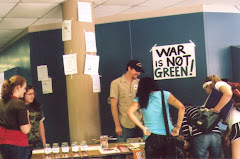
News came today from Veterans for Peace that VFP Executive Director, Garett Reppenhagen was arrested in Washington DC as part of the #FireDrillFriday action. Today's action theme was the protection of the earth's water. Here is what Garett said as part of his testimony:
'War is general is destructive to our planet in so many ways. In Iraq, I saw firsthand demolition of utility infrastructure. Destroyed plumbing made available clean water scarce and further damage to waste systems contaminated water supplies. The fertile crescent was nurtured by the Tigris and Euphrates Rivers, now too polluted to swim in. Today, precious few can even now count on something so simple as a safe cup of tap water.' 'When I came home, I became very self-destructive. I was a sniper in Iraq and because I perpetuated those crimes, I felt a heavy weight of grief and guilt, and finding my way into activism started to save my life. Repurposing myself and finding a new identity in the movement to serve this country in an HONEST way and protect my communities in a REAL way allowed me to start healing my moral injury.'
Teaching Climate Change and Environmental Justice Thursday, November 21University of Texas Austin College of Education
Dear Texas Rethinking Schools friends, We are happy to announce that while in Austin for the National Council for the Social Studies annual conference, Rethinking Schools editor Bill Bigelow will offer a free full-day workshop on teaching about climate change and environmental justice on Thursday, Nov. 21, 2019 at the University of Texas Austin College of Education.
University of Texas Austin College of Education Thursday, Nov. 21, 2019
8:30am to 3:30pm
Ideal for in-service and pre-service teachers, other school staff, curriculum coordinators, teacher educators, school media specialists, and environmental justice activists.
Meet the Teaching People’s History Team at NCSS 2019
And if you are going to the National Council for the Social Studies in Austin, Nov. 22-24, visit the Zinn Education Project booth in the exhibit hall, and attend workshops led by Rethinking Schools editors, Adam Sanchez, Ursula Wolfe-Rocca, and Bill Bigelow. More details here.
This piece is re-posted from medium.com
And included in the work to reverse climate change must be curbing US militarism, a major cause of environmental destruction around the world. Human beings are capable of nonviolent conflict resolution, in ways big and small. Just as these youth leaders are showing, policy change must rely on diplomacy and active nonviolence, not military force.
The Future Has It’s Eyes On You: The Time for Urgent Climate Action is Now.
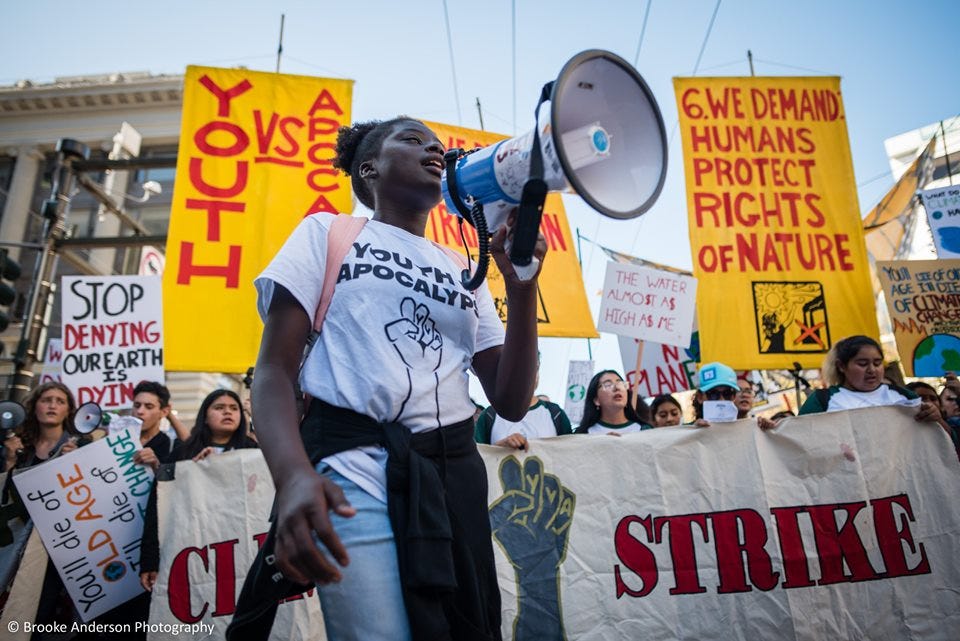
Asorahfay, age 12, leads a march of an estimated twenty thousand youth and allies Photo by: Brooke Anderson
Growing up, I had no idea what climate change was. Two years ago, when I was in sixth grade, I learned the truth. I learned about fossil fuels, I learned about the rising sea levels, and about the future I would have to live in.
Can you imagine the panic in a 12 year old’s mind when they realize that their future is in danger, and the adults had time to save it? My stomach still turns thinking about it. I can’t count the number of nights I have stayed up just thinking about it.
Can you imagine how nerve-wracking it is to talk to government officials with power over the air you breathe, when you’re only twelve years old? Can you imagine what it feels like having to comfort your six-year-old brother, trying to reassure him that climate change won’t kill him? Imagine hugging a child, and listing ways they can help the planet just so they can fall asleep.
Can you imagine what it’s like to go to a CalSTRS board meeting to lobby for fossil fuel divestment and be told that your comments won’t be recorded because you are under 18? You might feel like no one’s gonna hear you. You’ll just be silenced.
As youth, we are constantly silenced. But we won’t be anymore.
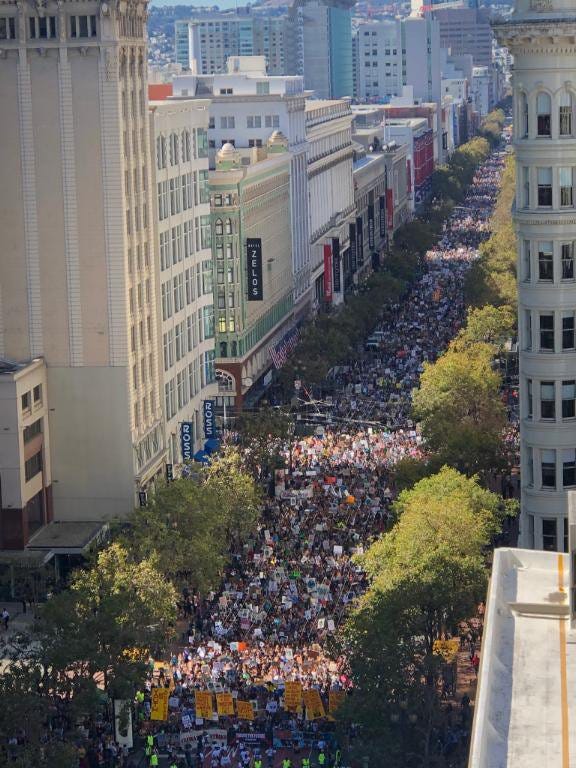
The Youth-Led Climate Strike in SF on 9/20/19
What do you do when you are silenced and those in power won’t listen to you? For me and other climate strikers around the world, we strike. We protest. We chant at the top of our lungs, until someone starts to hear us. If disrupting the peace is the only way you’ll listen, then so be it. We won’t let you go about your business as usual as our future disappears before our eyes.
Those of you who have been sitting this struggle out: you can’t ignore the constant signs of global catastrophe anymore. What will you say to your great-grandchildren when they ask you what Earth was like when you were younger? What should I tell my grandchildren, when they are coughing up smoke from a burning planet? Of course I’ll tell them I did everything I could. I’ll tell them I spoke truth to power, even when power didn’t want to listen. But what will you say? Did you really do everything you could? If you haven’t yet, what can you do now?
This is why the climate strikes are so important: when we all stand together, we can’t be ignored. There’s something thrilling about marching with thousands of youth for the same cause. Something thrilling about knowing that in some way, you are fighting for what many adults refuse to acknowledge.
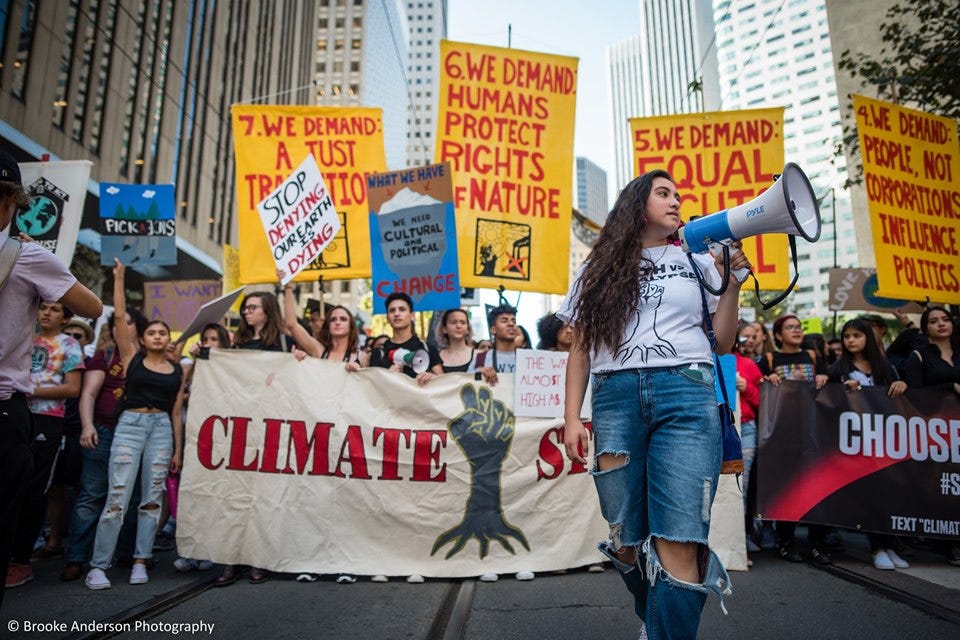
Hannah, age 16, leads the march in SF on 9/20/19 Photo by: Brooke Anderson
On Friday September 20th, an estimated 20,000 youth strikers along with adult supporters, marched in San Francisco. This was the Global Climate Strike, and alongside us there were 4 million people also striking across the world. On Friday September 27th, we held our climate strike at Chevron, to demand that they stop killing our planet and polluting frontline communities. In the week as a whole, more than 7 million people took action to fight for climate justice. The action was empowering and gained so much attention from around the world.
But the crisis is not over. Join us. You are also responsible. When future generations look into their history books, which side of history will you be on? Just remember, the future has its eyes on you.
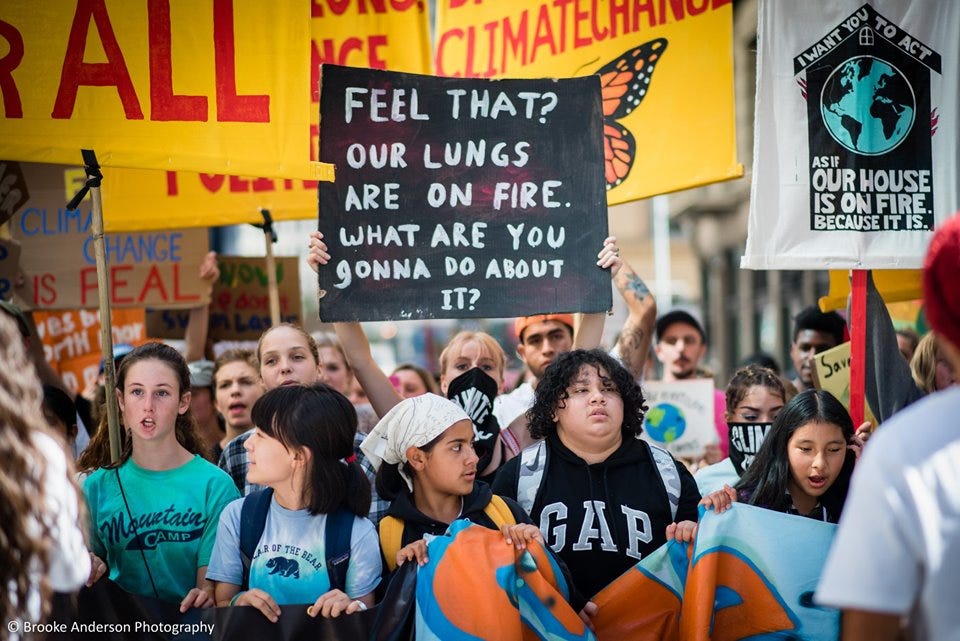
Protestors challenge us to act, Photo by Brooke Anderson
Check out this video produced by the National Network Opposed to the Militarization of Youth. The exciting movement galvanizing young persons today in working for a Green New Deal and addressing human-made climate crises must include stopping the militarization of our planet. The US military, in its spread of some 800 bases around the world, is the earth's single largest institutional polluter. Reversing climate change and preserving our planet's natural resources must go hand in hand with stopping war and the preparation for war.
Great turnout for the Austin Climate Strike yesterday at the TX State Capitol -- organized by students! Millions rallied and marched worldwide in defense of the planet. We can't have a healthy planet without stopping war and militarism.
Kumi Naidoo, then-executive director of Greenpeace International, attended the World Economic Forum in 2013. (Photo: World Economic Forum/Flickr/cc)
In a personal plea sent to tens of thousands of schools around the world Wednesday, Amnesty International secretary general Kumi Naidoo called on educators and administrators to allow students to join global climate strikes later this month.
"The climate emergency is the defining human rights issue for this generation of children." —Kumi Naidoo, Amnesty International
"I believe that the cause for which these children are fighting is of such historic significance that I am writing to you today with a request to neither prevent nor punish your pupils from taking part in the global days of strikes planned for September 20 and 27," wrote Naidoo, whose letter has been sent to school officials in Canada, Hungary, Spain, New Zealand, and the United Kingdom.
Inspired by the Fridays for Future school strikes that launched last year—for which students worldwide have taken to the streets to demand that governments pursue more ambitious climate policies—campaigners of all ages have registered thousands of events across the globe that coincide with an upcoming United Nations climate summit in New York City. The week of action will be bookended by the strikes Naidoo mentioned in his letter.
"The climate emergency is the defining human rights issue for this generation of children," wrote the leader of the world's largest human rights group. "Its consequences will shape their lives in almost every way imaginable. The failure of most governments to act in the face of overwhelming scientific evidence is arguably the biggest inter-generational human rights violation in history."
"By taking part in these protests, children are exercising their human rights to freedom of expression, peaceful assembly, and to have a say in decisions and matters that affect their lives," he continued. "In doing so, they are teaching us all a valuable lesson: the importance of coming together to campaign for a better future."
Naidoo has long history of campaigning for social justice issues. He became the head of Amnesty in December of 2017, after serving as executive director of the global environmental organization Greenpeace International. In his letter to schools, Naidoo recalled his experience being expelled at age 15 for organizing an anti-apartheid protest at his school in Durban, South Africa.
This setback redoubled my commitment to learning, and thankfully I was able to complete my studies and ultimately take up the role I have the honor of holding today. But I also had something that children of this generation do not have: the chance to imagine a future that is not overshadowed by the prospect of a climate emergency.
My experience also informed my strong belief that children should not be punished for speaking out about the great injustices of our age. In fact, when it has fallen on young people to show the leadership that many adults who hold great positions of power have failed to, it is not young people's behavior we should be questioning. It is ours.
Naidoo returned to his home country this week to attend Financing the Future, a historic divest-invest summit in Cape Town that began Tuesday—which came after Amnesty's Global Assembly voted last month to divest from the dirty energy industry.
"Every person facing deeper levels of drought, stronger hurricanes, or conflict has been wronged by these fossil fuel companies," Naidoo said Monday. "Their rights to health, water, food, housing, and even life have been harmed, which is why Amnesty International has decided to divest from fossil fuel companies."
Like the climate strikes, the global divestment movement began with young people. A report released Monday by 350.org and DivestInvest detailing divestment commitments worldwide noted that "what began as a moral call to action by students is now a mainstream financial response to growing climate risk to portfolios, the people, and the planet."
A new show of art at the Austin Central Public Library by Calder Kamin is a brilliant exhibition of pieces depicting animals at risk of extinction. The pieces are constructed of pieces of trash -- plastics and other non-biodegradable materials that are part of the problem in our earth's fight for survival. Kamin dedicates the show to the youth who are now on the forefront of the movement for immediate action on climate change. Kids who came to the Kamin exhibit were invited to make posters to add to the display, and this is one. Indeed, a major part of our efforts to stop harming the environment must be to stop war and militarization. The US military is still the largest institutional polluter in the world. What is supposed to be "defense" is really offense. What is supposed to protect people is really hurting people. We do need a climate of peace in order to preserve our planet.
Upon learning last Saturday from an article in the Austin American-Statesman that Austin is one of 5 cities being considered as the site of a proposed "Army Futures Command Center," I wrote a letter to the editor, which was published in today's edition, to express opposition to this. I wrote also to our Austin City Council members and the following letter to members of the Economic Development staff at the Greater Austin Chamber of Commerce:
Dear member of the Economic Development staff, Austin
Chamber of Commerce,
I write to you as a concerned, longtime Austin resident in
response to the article in the Austin American-Statesman on Saturday, June 16,
“City 1 of 5 finalists for Army site.”The article indicated that the Austin Chamber of Commerce supports the
idea of having a proposed Army Futures Command Center placed in Austin.
Reading this article was the first I learned of the Army’s
selection of Austin as a possible location for this center.The article also indicated that the final
city selection may be made by the end of this month.This offers very little time for any
community input.
I do not agree that Austin would be a suitable location for
this Army site.The primary purpose of
the Army center, as described in the Statesman article, apparently would be to
enhance the Army’s arsenal, “including improvement to its tactical missile
system, combat vehicles and helicopters, defense teams and weapons.”Is that really what we want in Austin?The Army says it wants a “creative culture”
in which to place its facility, but weapons are not creative, they are destructive.
I have worked along with many military veterans over the
years and have witnessed what the weaponry and tactical systems of war kill in
a person even when the person survives.There is too much life-long trauma, too much physical and moral injury,
too much suicide.I’ve also witnessed
the trauma borne by refugees who have fled US wars.
Please, let’s use our high-tech, creative genius in Austin
for what really enhances life: excellent health care, fine education, green
energy development, efficient communications and transportation systems, good
maintenance of our infrastructure and wise stewardship of our natural
resources.
Hart, Tami and I had a really good day of tabling at Bowie HS today. I'd salvaged some old calendars with wonderful photos of wild animals from around the world and made a poster with some messages from the animals' points of view. Student responses to the question that related to the poster got right to the point: wars create loss of habitat through building of military bases, outright destruction of habitat and food sources, injury and death from radiation and other weapons like land mines, and people turning to crime like selling elephant tusks because of war-related effects on communities. One student also mentioned that the proliferation of weapons caused by war also can lead to more poaching of wild animals, which surely is true.
The Penny Poll results showed the highest priority for Health Care at 26% of the budget, Education at 24%, the Environment at 21%, 11% for the Military, 9% for Humanitarian Aid and 9% for NASA. During our tabling, a JROTC squad practiced marching maneuvers right outside the windows from our spot. Several students who visited the table and did the t-shirt challenge mentioned plans that included military service, so we were glad to be able to talk with them and offer them some alternative information.
Because MLK Day is coming up, our reflection question related to that. Many students mentioned boycotts in their responses, but didn't mention specifics when it came to what is or could be boycotted now. We will have to explore this more in future tablings.
We had to smile at this school banner. A spoof, perhaps, on the current US president?
I liked seeing this bumpersticker on our intrepid driver, Tami's car!
Joshua Casteel, speaking at the Truth Commission on Conscience in War
The following story was carried by The NPR radio program, The Texas Standard this week. When we caution students that the US military is the biggest single institutional polluter in the world, this is among the reasons why. And when we caution students that veterans have become ill from exposure to the toxins produced by the military and often have suffered further from inadequate medical care, this is another example.
I especially remember Joshua Casteel, an Iraq War veteran who died at the age of 32 in 2012 of cancer attributed to exposure to US military burn pits in Iraq. Joshua became a Conscientious Objector to war after his experiences as an interrogator in Iraq. He was one of the veterans featured in the film, "Soldiers of Conscience," and he spoke widely on the issues of moral injury and conscience, including an audience with the Pope. Joshua was a beautiful person, and he, along with every person who died too soon because of the effects of war, should have lived.
Here is the story that aired this week:
Closed Doors and Toxic Fumes: Veterans Affected by Military Burn Pits Grow Desperate
by Carson Frame
For years, veterans say they’ve been getting sick. They believe the culprit is open burn pits used in Iraq and Afghanistan. A class-action lawsuit against Houston-based military contractor Kellogg Brown and Root was thrown out this summer, and many of those affected don’t know where to turn.
Listen
Listening...
5:30
Army Reserve Captain LeRoy Torres will never forget the 10-acre plot of land, full of burning garbage, located about a mile from his sleeping quarters at Balad Air Base in Iraq. The year was 2008.
All the military’s waste was thrown into the pit, doused with a jet fuel known as JP-8, and set on fire.
“You’d see tires, plastics, batteries. Large bottles and containers of fluid, no telling what it was,” Torres said. “Solvents. Medical waste. You’d see those red medical bags from the hospital just being tossed in the fire.”
Staff Sergeant Jeremy Daniels arrived at Balad in 2005. He remembers seeing items destined for the flames.
“It doesn’t matter if it comes out your room, if it comes off your body, if it comes out your body. Go down there and light it ablaze.”
At the height of its activity, the Balad pit burned about 200 tons of trash each day.
The smoke it gave off was overwhelming, especially when the wind blew a certain way. It stuck to people’s clothes, filled their lungs, and got in their eyes.
“It was a cloud. You wore it,” he said. “If you walked around on that post, you smelled like it. It is the most horrid sulfuric smell you have ever frickin' smelled.”
LeRoy Torres agrees. “There were times—I remember one time clearly—I couldn’t even see the road 6 feet in front of me,” he said.
Soon after they arrived at Balad, both Torres and Daniels got sick. Torres started coughing up a black mucus that military doctors called ‘Iraqi Crud.’ It was the result, they said, of his body getting used to the environment in-country.
Daniels developed a weeping rash on his lower extremities that didn’t resolve for months. The skin sloughed off and bled. Doctors suggested that he was allergic to his laundry soap. Then he developed fourth nerve palsy, a neurological disorder that affects vision.
“While I’m walking to work, my left eye goes up and to the right while I'm still trying to look forward. I end up with the worst drunken double vision I've ever seen.”
After they returned home, the issues got worse. Torres’ respiratory problems were given a name: constrictive bronchiolitis, an untreatable and often fatal lung injury. Daniels' neurological problems were labeled ‘relapsing multiple sclerosis’ with an ‘extremely aggressive onset.' He now uses a wheelchair.
Both men were medically retired from their jobs. They both blame the burn pits for their health problems.
The use of open burn pits continued until 2009*. Hundreds of them were scattered across Iraq, Afghanistan, and Djibouti.
THE DISCONNECT
By the end of the decade, VA was grappling with an influx of disability claims related to toxic exposures from the burn pits. Kerry Baker was the Chief of Legislative and Policy Staff for V.A’s Compensation Service at the time. He now works as a VA appellate practitioner.
“Because the claims being filed by veterans for disability related to those burn pits and other exposures were increasing, V.A. had to come to terms that they didn’t have any real policy instruction for thousands of adjudicators out in the field for how to process those claims.”
To fix that, Baker helped publish a 2010 V.A. training letter on potential environmental hazard incidents, including burn pits.
The letter lists DoD air sampling results taken at Balad Air Base in 2007. A swathe of carcinogenic chemicals and dioxins were released as byproducts of burning trash. One of them is similar to Agent Orange, the defoliant that made soldiers sick in Vietnam.
Capt. Torres,’ wife, Rosie, has a copy. She brings it along to all of her husband’s doctors’ appointments.
“You can go to the VA and they’re like, ‘What are you talking about? Burn pits?’ So when you take this letter to a doctor at the VA, they don’t know what you’re talking about. Not even the environmental coordinators know what you’re talking about.”
Kerry Baker thinks that’s disappointing, since the letter was incorporated into the VA’s claims operating manual.
“That tells me that beyond that letter, the VA has not done anything since to really educate its people on the subject," he said.
The VA’s official stance on burn pit exposures is blunt: “At this time,” it says, “research does not show evidence of long-term health problems from exposure to burn pits.”
But research in this area is challenging. Given that so many different items were burned in so many different places, creating a framework for studying the burn pits has been all but impossible. A study by the Government Accountability Office last year found that the Department of Defense “needs to fully assess health effects” of open burn pits.
The VA currently administers a national burn pit registry where veterans can fill out a questionnaire to report exposures to airborne hazards. However, veterans often do not complete the survey. It also does not permit death entries.
Add to that the problem of other exposures that soldiers face: sand and dust naturally present in the air, pollution, IED explosions, fires.
That cone of uncertainty has a cost. Many veterans struggle to document their exposures in a way that’s sufficient to get VA compensation. Some vets are told that their symptoms are psychosomatic, or the result of milder conditions.
Jeremy Daniels believes that this amounts to systemic denial.
“I'm not a doctor, but I'm going to say that the Army and the VA want to create their own narrative as to what's wrong with people,” he said.
SETBACKS AND STEPS FORWARD
2017 has been a year of setbacks for those who suffered as a result of the burn pits. The Texas legislature failed to pass a bill that would have created a burn pit registry to collect health data and provide affected veterans with a way to connect with one another. The bill was opposed by a group called Texans for Lawsuit Reform, which expressed concern that a public registry would be used as a tool for class action lawyers to recruit new clients.
In July, a federal judge dismissed a class action lawsuit against Kellogg Brown and Root, the Houston-based contractor in charge of the burn pit at Balad. He said that the company acted on behalf of the U.S. military, and couldn’t be held liable for soldiers’ illnesses.
Capt. LeRoy Torres was part of that lawsuit. His wife Rosie said that he’s barely talked about the defeat.
“Just because he's gone through such a tough time losing his career already, I didn't want to spend time asking. Because I know that for a lot of veterans like LeRoy, it's just another step in the wrong direction. Another reason for them to become hopeless.”
Veterans and their families are growing desperate for accountability. Rosie Torres says that if Kellogg Brown and Root isn’t held responsible, the government needs to pick up the slack.
“If they're not gonna hold them [KBR] accountable, then the federal government should step up and take care of these soldiers that are dying. Take care of them, take care of the gold star families, their widows, their children that are being denied benefits time after time after time,” she said.
The Torres family have funneled their frustrations into a nonprofit called Burn Pits 360, which acts as a source of information and support for vets. Burn Pits 360 went before Congress earlier this year to spread awareness about the issue.
Texas Congressman Joaquin Castro has helped in their cause, co-sponsoring the Helping Veterans Exposed to Burn Pits Act, which would create a VA Center of Excellence in the prevention, diagnosis, mitigation, treatment, and rehabilitation of health conditions related to burn pit exposure. On Oct. 26, Rep. Castro requested a Congressional hearing on the issue.
“I really believe, after looking at everything that this could be the equivalent of Agent Orange in Vietnam. Where, for a while, people were ignored or not believed even though they were exhibiting symptoms,” Rep. Castro said in an interview.
Despite these glimmers of progress, Staff Sgt. Jeremy Daniels said he feels discouraged. He has traveled widely over the last year, seeking out different VA hospitals and trying to get the support of political advocates.
“Nobody wants to listen,” he explained. “I've called the White House. I called our Governor. I called two different Congressmen here in Texas. Because with all these people coming home and getting sick… They have to own up to what the hell they've done to us.”
*Although open burn pits were officially discontinued in 2009, there have been allegations of their use since.
From 1997 to 2019, we did direct outreach in the public high schools in Austin, Texas as an alternative to military recruitment in the schools. We are committed to the use and advocacy of nonviolence. Our group has included students, teachers, activists, veterans and parents.
We're on Facebook at https://www.facebook.com/SOYPeaceOptions
I co-coordinated Sustainable Options for Youth (Nonmilitary Options for Youth) in Austin, Texas until May, 2019. The Sustainable Options for Youth blog describes activities of SOY in the schools and includes information about other work like ours around the country. Wage peace!