Showing posts with label JROTC. Show all posts

Friday, January 27, 2017

Talking careers and fairness at the Reagan HS career fair


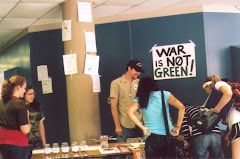
Yesterday, Hart, Regina, Tami and I had a full and inspiring day tabling at the annual Reagan HS career fair.  Representatives from a number of colleges, businesses and community organizations were set up in the gym.  We were there to provide a different view of military life and militarism than the military recruiters who also were present.  Reagan HS has a JROTC program, and JROTC students were dressed in uniform.  A number of them came by our table to participate in the t-shirt challenge and talk with us about their plans for the future.  Hart and Regina as military veterans spoke with students from their own experience.  Regina had brought two jacket art pieces from her Fatigues Clothesline Project to display at our table.  The jackets were covered in statements by veterans who have experienced Military Sexual Trauma (MST), one of the serious issues we raise in our materials.


About 75 students completed the t-shirt challenge over the course of the career fair, and it was good to talk with students about their hopes and plans.  Two students told us about having participated in the historic Women's March on Austin last Saturday (Regina and her daughter and I had also participated), as did a Reagan teacher who stopped by the table, and they all spoke about how empowering and encouraging the huge march and rally were, and we agreed!  We in SOY are very much opposed to the Trump agenda that is already increasing anxiety among families in our community.  Life is challenging enough for our young adults who are working hard and hoping to further their education.  Adding more worry and hardship by threatening to separate families, cut financial aid for college and create more division between people is cruel and damaging to our social fabric.
The Penny Poll results showed the Health Care category as the biggest priority with 28% of the penny vote, closely followed by Education with 27%, then 22% for the Environment, 13% for Humanitarian Aid and 10% for the Military.  As always, if our high school students could decide on our national priorities, we would have a much healthier, better educated society and a more protected planet.
There were 75 written responses to our reflection question, and the majority of students cited racism as the primary supervillain that requires resistance.    Following is a sampling of their responses that are indicative of what was written over all.  Thank you to all Reagan Raiders for engaging with the questions we raised in the t-shirt challenge and for expressing your thoughts on these crucial issues.

A sampling of the student responses to the question:

"Of the Supervillains: Racism, Sexism, Poverty, Militarism and Ecocide, which will you resist?  How?"


Racism – I will resist racism because I am an immigrant that has also been discriminated against and now more than ever I will stand up to racism because “our president” thinks it’s okay to discriminate against people, and as a “citizen” if this country, I WILL NOT let racism happen in my community or around me.
I will resist all the above issues, including Trump’s immigration policy, racism and discrimination.  I will do this by marching, calling my representatives, speaking out on daily discrimination and write and document.

Racism because I believe that we’re all the same regardless so we need to stand up to that!

Sexism because there are still a lot of things that society says women can’t do.

As a rising female, I’m against gender norms.  I don’t believe a woman should only be in the house and only the men should work.  How about we flip the table and let them do this.  Women should be treated equally.  Women overcome so much and I’ll try my best to end it.  I want to make a better world where your gender doesn’t affect anything.

Racism affects me because I am judged because I wasn’t born here, and I want to change this because it’s not about race, it’s about culture, and I am proud to be Mexican.

Poverty, I would try to eliminate all currency in the world.

Of these supervillains, I will resist all.  Just resisting one will make no change.  We have to resist all and come together.

In my opinion, racism would be what I would resist because racism is an every day thing.  And no one is different, everyone is equal to one another and you being a different race does not make you any different from them.

Racism – I would speak publicly about it.

Racism, because no matter your race, you’re still a human being.

I believe that I can resist all of them with understanding and treat everyone with respect because we are all human.

Racism, because it’s all over and people should work on getting along with each other.  What I would do to address it is help people if I see racism around.

I plan to resist ALL, but I will resist racism because people may be prejudiced against me, but it’s all about love at the end of the day.

I would protest against sexism.  I would gather up friends who feel the same and we would protest together.

Racism – because it’s been a constant problem in my people’s history.

Mine is racism – one of the reasons it bothers me is because my family is Mexican and I don’t like it when they get treated bad or called names.  A way that I would change this is by doing my best and show that they are wrong about us.

Racism -- more activity involved with diversity culture.  Sexism -- nothing I can do to change people’s beliefs, just hoping people will open more to the transgender community.

I would make everyone see all the ways we can treat everyone with the same respect and how if all the world united and treated everyone with the same respect, the city would be much better and accomplish more goals in the world.

Ecocide—We need to take care of our environment b/c we live in it.  Racism – We need to respect everyone the way they are.

Racism – because I will let people know how I feel and I will let them know my rights.

I think racism is still a big problem around the world.  Like now w/ Donald Trump as our president, it’s going to be a bigger problem.  How can I stand for this?  I would always be equal to anyone I meet.

Racism – and I’ll try to teach people about history and why what’s happening is happening.  I won’t let history repeat itself.

Sexism – by proving I can be independent and successful before marriage and never relying on a husband.  I will also fight racism by proving immigrants can have a bright future.


Sexism and Racism – We should not be divided in any way such as the color of one’s skin: the only time colors should be separated is on laundry day.  We need to unite.


Friday, October 3, 2014

Rethinking Schools: feature article on JROTC

An excellent article published in the current Fall 2014 issue of Rethinking Schools:

The Military Invasion of My High School

The role of JROTC


Air Force JROTC students from Buena Park High School, Coronado, California, 2006.
U.S. Navy photo by Hermes Crespo
“Will you please write me a letter of recommendation for the Navy, Ms. McGauley? You’re my best class.” Thanh was enrolled in the recently established Junior Reserve Officers’ Training Corps (JROTC) at our high school and he, like many of my students, was enamored with the military’s alluring promises of a magic carpet ride away from poverty and uncertainty.
My heart ripped as I listened to Thanh’s plea. I want to do what is best for my kids. I want to support and honor them in making their own informed decisions. But, given the impact of JROTC at our school, I felt very uneasy about the balance of information students like Thanh were receiving about enlistment in the U.S. military. After much discussion with Thanh, I wrote an honest letter, emphasizing his sensitive poetic nature and his commitment to fairness. The Navy eagerly welcomed him.
The sprawling campus of Reynolds High School (RHS), the second largest high school in Oregon, rests atop a ridge at the entrance to the scenic Columbia River Gorge in tiny Troutdale, 17 miles east of downtown Portland. When I first started teaching here 23 years ago, Reynolds was an almost all white, working-class, conservative, sub-rural community, culturally distinct from its larger urban neighbor. As Portland has become more gentrified, lower rents have attracted numerous low-income families—immigrant, African American, Latina/o, and white. Today, the Reynolds School District is a high-poverty, culturally diverse district with two of the poorest elementary schools in the state—perfect prey for military recruiters who win points for filling the coffers of the poverty draft.
During the Vietnam War era, much was written about JROTC’s role in teaching military training; today JROTC high school (and even middle school) programs incorporate a broader curricular agenda and are expanding rapidly. Yet, within the education community, little has been written about the implications and effects of JROTC in schools.
The potent presence of the military at RHS shines a floodlight on educational inequity. One sees college recruiters walking the halls of affluent Lincoln High School near downtown Portland. At RHS, college recruiters are few and far between, but military recruiters, JROTC commanders, and ASVAB (Armed Services Vocational Aptitude Battery) testers clamor to establish daily contact with potential recruits.
All too often I hear the refrain: “Well, the military is a good option—or perhaps the only option—for many kids.” As educators, we must ask critical questions: Whose interests do we ultimately serve by welcoming the military into our poorer schools? Is it really in any of our students’ best interests? What are the qualifications of the instructors? What does the JROTC curriculum actually teach our students?

JROTC 101

The National Defense Act of 1916 established JROTC to increase the U.S. Army’s readiness in the face of World War I. The ROTC Vitalization Act of 1964 directed the secretaries of each military branch to establish and maintain JROTC units for their respective branches. In the 1990s, the programs began expanding rapidly throughout the country. Today, there are approximately 3,500 Army, Air Force, Navy, Marine Corps, and Coast Guard JROTC units in schools in the United States and its territories. Last year, Congress instructed the secretary of defense to expand further and to report on “efforts to increase distribution of units in educationally and economically deprived areas.”
JROTC is not about education. But by housing recruiters and JROTC in public schools and offering them carte blanche privileges, we provide them a cloak of legitimacy. Militarism was one of Martin Luther King Jr.’s “giant triplets” of societal destruction (along with racism and extreme materialism), yet today it appears as a legitimate component of the educational system—most often at underfunded schools.
At our school, JROTC is an actual school within a school, one that offers four levels of classes for which students earn full credits. It meets state requirements for career training. At RHS and many other schools, it is accepted as a substitute for physical education. Our JROTC instructors have also given make-up credit for writing and study skills classes, using online programs in the main JROTC classroom. The RHS program is directed by Brian James, a retired colonel from the Oregon Army National Guard, who tells me he looks forward to being able to offer health, history, and government credits as well.

Promoting Gun Culture at School

RHS has embraced school-based initiatives, including a commitment to restorative justice and peer mediation, that teach and encourage students to resolve conflicts nonviolently. JROTC’s militarism runs counter to these programs. Schools across the country are employing a variety of methods to curb bullying and violent incidents, create safe learning environments, and teach peaceful means of conflict resolution. JROTC’s introduction of weapons training, its partnership with the NRA to sponsor marksmanship matches, and its modeling of authoritarian militaristic solutions to problems contradict the schools’ stated opposition to violence.
Critics have been successful in getting JROTC to discontinue the use of live weapons in schools on a national level, but units continue to use air rifles for target practice at RHS and numerous other schools. Organizing makes a difference. In San Diego, for example, the Education Not Arms Coalition, made up of students, teachers, parents, and community groups, successfully removed target practice with air rifles from San Diego JROTC programs in 2009.

One School’s JROTC Story

In 2011, a former RHS principal, with the support of the school board and many staff members, laid down the red carpet for JROTC to create a program at our school. The JROTC contract requires the hiring of a minimum of two retired officers for the first 150 students enrolled as cadets. After 150, another instructor must be hired for each additional increment of 100 cadets. James and other retired military personnel teach courses in military science, called Leadership Education Training (LET), during the school day.
Three full-time JROTC instructors lead 13 sections of LET 1, 2, and 3 to 280 students. Last year, a new principal tried to make the JROTC class loads comparable to other teachers’ loads by laying off one of the commanders. Although the effort failed, James says he does not plan to ask for additional staffing at this time: “Even though I won that fight and she’s gone, it’s political. I’m a laid-back kind of guy, but if you push me into a corner, I’ll fight back and I’ll win. . . . I brought in the superintendent and the school board, the mayor of Troutdale, and the commander at Fort Lewis. We’re all still here, and she’s gone.”
James adds that they really should have a fourth officer since their “job is bigger than a teacher’s. We teach, mentor, and coach kids, and we take them on excursions. We take them to Florida and other places for rifle competitions.” Every teacher I know teaches, mentors, and coaches students; and if we had the Pentagon’s money, we would take them on many more excursions.
At RHS today, student loads for most non-JROTC teachers hover between 180 and 220 students (more than twice the load of the JROTC instructors) with class sizes in the 30s and low 40s. JROTC cadets often take LET in place of physical education, and a single PE teacher would normally support 250 or more students. If JROTC were eliminated at RHS, the district would hire fewer than half as many teachers to replace them—although it would be wonderful for our students if we, too, had student loads of 70 to 90. In general, the federal subsidy covers less than half the total salaries and none of the employment taxes or benefits for JROTC instructors. Schools wind up using extra money from their budgets to, in effect, subsidize a high school military training/recruiting program for the Pentagon.
JROTC instructors are not certified in the same way as other school district teachers. In some states they are not required to have more than a GED (although the commander must have at least a BA). Generally, the military decides who is qualified to be a JROTC instructor and then presents them to the school district for hiring. According to James, each of the three JROTC instructors at RHS has at least a BA. He says getting certified to teach in the program is “a double whammy because we have to be certified by both the state of Oregon and the Army.” (There is no required teacher training; Oregon simply requires JROTC instructors to take a test on the history of discrimination in Oregon.)

Teaching Militarism, Not Critical Thinking

The Reynolds LET 1 course description apprises students that they will learn “leadership, follower, and citizenship skills.” JROTC is military training. Instead of teaching toward a just and peaceful world, military training emphasizes dominance and nationalism. In fact, once students enlist in the military, they are no longer guided by the United States Constitution. Rather they are governed by the Uniform Code of Military Justice.
The Pentagon contracts with Pearson to write JROTC curriculum, including social studies, health, and leadership textbooks. The local school district has no control over their content. No process exists for regular certified staff to review JROTC materials for appropriateness, accuracy, or conformity to educational standards.
Teachers focused on social justice are critical of the historical perspectives of many mainstream textbooks. But, because the JROTC curriculum is focused on developing leaders for the U.S. military, there is a specific danger to these texts. For example, Lesson 2 of the LET 3 textbook is titled “Ethical Choices, Decisions, and Consequences.” The authors compare and contrast the Vietnam and Iraq Wars. They state that the sole cause of the Vietnam War was containment of communism: “American military personnel began deploying to Vietnam in 1954 to strengthen the country against communist North Vietnam.” The authors cite then-President Johnson’s 1964 statements that North Vietnam attacked a U.S. destroyer in the Gulf of Tonkin as the impetus for the broader war, ignoring overwhelming evidence from declassified documents that there was no such attack.
The narrative continues: “The United States went to war in Iraq as part of its global war on terrorism.” In the same paragraph, the authors introduce Osama bin Laden and explain the creation of al-Qaeda “to dislodge American forces in the Middle East.” The implication is clear—Saddam Hussein and Osama bin Laden were working in cahoots to attack the United States. To further cement this alleged relationship, which did not exist, they quote George W. Bush: “Iraq could decide on any given day to provide a biological or chemical weapon to a terrorist group or individual terrorists. Alliance with terrorists could allow the Iraqi regime to attack America without leaving any fingerprints.” Nowhere in the case study or various historical timelines do the authors indicate that both Hussein and bin Laden were at one time strongly supported by the United States. Describing the arguments for the second Gulf War, the text notes a “lack of indisputable evidence” (as opposed to the presence of manufactured false evidence) that Iraq had weapons of mass destruction.
In outlining alternatives to these military invasions, the authors identify the only potential consequences as unacceptably negative. In the case of Vietnam, they cite the “domino theory,” which predicted one country after another becoming communist threats to the United States. In the case of Iraq, they quote then-President Bush without additional commentary: “We cannot wait for the final proof—the smoking gun—that could come in the form of a mushroom cloud.”
Lesson 3 is on “Global Citizenship Choices, Decisions, and Consequences.” The authors discuss intelligence as a tool of U.S. foreign policy: “The CIA focuses mostly on countries it thinks might be unfriendly. . . . Sometimes intelligence agencies have helped overturn the government of a country. . . . For example, the CIA took part in overthrowing the government of Salvador Allende. The United States government thought Allende was not favorable to our national interest. Like defense, diplomacy, foreign aid, and trade measures, intelligence is an important tool of foreign policy.” There is no questioning of the U.S.-led coup against the democratically elected president of Chile, nor is there any discussion of the consequences and implications of the decision.

“The greatest purveyor of violence...”

The sole mission of the U.S. military is to prepare for and fight wars. JROTC in middle and high schools, ROTC in colleges, the ASVAB test, military partnerships with schools, research and development programs—all are designed as tools for fulfilling this goal. Military recruiters and JROTC personnel are notorious for not disclosing the whole truth and for making seductive promises—verbally and in writing—that can be broken at any time. For example, students and staff are often told that undocumented students will receive legal citizenship papers if they enlist. This is false. By law, undocumented immigrants may not enlist in the U.S. armed forces, or even enroll in JROTC. (Documented immigrants may enlist and can receive citizenship status for doing so if they fulfill all requirements. Last spring Pentagon officials approved a policy that would allow a limited number of undocumented young people “with critical language or medical skills” and who came to the United States as children to enlist in the military, opening a pathway to eventual citizenship.)
JROTC is a component of the U.S. military apparatus, what King called the “greatest purveyor of violence in the world today”—and nothing about the current world situation would encourage him to modify that statement. As educators, we need to teach students to read the world, to question, and to critically analyze the history of U.S. militarism. And we must get JROTC out of our schools.  
In June, after this article had been accepted for publication, an avid (and apparently mentally unstable) JROTC student at RHS armed himself with a semi-automatic rifle and pistol, a knife, and hundreds of rounds of ammunition. He fatally shot one student and injured a teacher before police cornered him and he took his own life. This tragedy highlights the importance of closing down programs that feed violent tendencies in vulnerable students and contradict school-based efforts to teach nonviolent conflict resolution.


Tuesday, December 17, 2013

War journalist, Ann Jones writes about JROTC

A message from Rick Jahnkow of the Project on Youth and Nonmilitary Opportunities about a recent article by journalist, Ann Jones about how JROTC programs train kids to be soldiers:

 
A powerful article that will stimulate some discussion: http://www.huffingtonpost.com/ann-jones/americas-child-soldiers_b_4450935.htmlTwo relatively minor errors: JROTC rifles now use gas-propelled pellets, and the minimum salary schools are required to pay instructors is not what their active duty salary would be (it's a more complicated formula, see "How JROTC Contributes to the School Funding Crisis" at http://www.projectyano.org/index.php?option=com_content&task=view&id=54&Itemid=62). 


--Rick JahnkowProgram CoordinatorProject on Youth and Non-Military Opportunitieswww.projectyano.org
__._,_.___

Monday, January 24, 2011

JROTC programs drain school district budgets


This analysis, by Rick Jahnkow, of the Project on Youth and Nonmilitary Opportunities is crucial information for every school board considering budget cuts, including Austin's. JROTC programs are poor substitutes for PE classes, not only because of the program content, but because JROTC programs COST MORE. As they deliberate how to cut costs, AISD should investigate the full expenses of JROTC and discuss cutting JROTC in favor of less expensive and more productive classes for high school students.


Jr. ROTC Contributes to the School Funding Crisis
by Rick Jahnkow

As sources of public money for public education shrink, K-12 school districts are being forced to consider budget cuts that will seriously affect classes and student services. In some places they are reducing or eliminating counselors, school nurses, teacher aides, librarians, and programs like art, music and athletics.

One program that is rarely subjected to cuts is the Junior Reserve Officer Training Corps (JROTC), a military training/recruiting program that is currently offered in approximately 4,000 of the nation’s high schools. Even though this course is a non-academic elective that does not count toward meeting admission requirements at state colleges and universities – and schools are scrambling to provide electives that do help students meet those requirements – JROTC is usually given privileged treatment by school trustees who are politically intimidated by the pro-JROTC lobby and often deceived about the money that could be saved by cutting the program.

There are a lot of reasons to be concerned about the presence of a military-run program in public schools – for example, the propagandistic character of the curriculum, the questionable credentials of the instructors, and the fact that JROTC brings marksmanship training into most of the schools where it exists. Public debate over these concerns, however, has never led school trustees to remove a JROTC unit. In large part, this is because of the well-organized lobby that emerges from JROTC classes themselves. There is considerable politicking by instructors, and the military structure of the program allows them to easily mobilize cadets and their families.

This lobby, however, has sometimes failed to prevail when a school district with major financial problems looks closely at the cost of JROTC. They discover that, in comparison to alternative classes, JROTC is much more expensive to maintain than school administrators and trustees have been led to believe. The reason their initial assumptions are often wrong is that promoters of JROTC encourage the false belief that federal money will cover any extra costs. After approving the program, most school administrators never realize that the partial subsidy offered by the Pentagon (which comes from its recruiting budget, by the way) does not match the additional expenses generated by the high staffing requirements of the JROTC contract.

How JROTC is a net drain on civilian school funds

Under the standard JROTC contract, the Department of Defense provides students with books, uniforms and special equipment such as pellet rifles. The school district must provide insurance, building facilities and maintenance, and must assume responsibility for paying instructors' salaries and all the normal employment taxes and benefits that cover regular teachers. JROTC instructors must be retired military officers approved by their military branches. They are not required to meet the same qualifications as other teachers.

The school district receives from the DoD only a partial contribution toward instructors’ salaries and nothing toward the substantial cost of employment taxes and benefits. The subsidy amount for each instructor is calculated based on the military pay and housing allowance the officer would receive on active duty, minus his or her military retirement pay. This difference is then cut in half and the result is the maximum amount the DoD will pay the school district.

The JROTC contract requires the hiring of a minimum of two retired officers (one a non-commissioned officer) for the first 150 students enrolled as cadets at a school. After 150, another instructor must be hired for each additional increment of 100 cadets (e.g., three instructors for 151-250).

It’s important to note that only one non-JROTC classroom teacher would normally be hired to teach 150+ students. Furthermore, JROTC cadets are generally allowed by schools to take the class in place of physical education, and a single PE teacher would normally support 250+ students. So if JROTC were eliminated in a school district, less than half as many teachers would need to be hired to replace them.

In other words, to have JROTC, a school district must more than double the staff normally required for the number of students involved. Because the federal subsidy amount will likely cover less than half the total salaries and none of the employment taxes or benefits for two (or more) JROTC instructors at each school, schools wind up using extra money from their budgets to, in effect, subsidize a high school military training/recruiting program for the Pentagon.

An example of a specific school district

When Air Force JROTC was introduced in 1995 at Vista High School in Vista, California, the projected net cost to the district for two JROTC instructors to teach 95 cadets was:

Salary, plus taxes and benefits $79,386
Federal subsidy -28,305
Net JROTC expense 51,081

In comparison, one PE teacher was allocated for an average of 250 students at Vista HS, therefore .38 of one PE teaching position would have been required for those 95 cadets. The total cost for that portion of a PE teaching position, including taxes and benefits, was $52,250 x .38 = $19,855.

The projected net loss to the Vista school district was:

Net JROTC expense $51,081
Net cost for .38 PE allocation -19,855
Net loss of funds 31,226

(Data source: Vista Unified School District, 1995)

If one assumes the same salary and benefits rates in a district with 13 JROTC schools (San Diego Unified, for example), the annual budget loss would have been $405,938 in 1995.

While it is certain that the numbers for salaries and benefits have increased since 1995, the basic formula for calculating the true cost of JROTC is the same today: determine the total net cost for all JROTC staff and subtract the total net cost for alternative teaching staff needed to support the number of students in JROTC. The difference will reveal how much additional money would be freed up for other uses if JROTC were cut from the district’s budget.

School trustees are often given budget summaries from district staff that include the net cost for JROTC, but without the critical comparison to the cost for substituting JROTC with classes like PE. This makes it difficult for them to make fully informed decisions about which programs to eliminate when they need to make budget cuts.

People who would like to draw a district’s attention to the true cost of the program should try to find out what JROTC budget figures have already been circulated, which may be available on a school district’s web site. If the information is not available, or if it is lacking a comparative analysis, school trustees can be asked to provide specific facts about the program’s cost. In the process, trustees may come to realize that their assumptions about JROTC’s economics were based on false or incomplete information. With a more accurate financial picture, they would be more likely to consider cutting JROTC as a potential way to resolve a budget crisis.

For a copy of this article in PDF format, go to the JROTC section of Project Yano. This article is from January-March 2011 Draft NOtices, the newsletter of the Committee Opposed to Militarism and the Draft.


photo by editor