Monday, October 20, 2008

Mural by "Voices Her'd": We Are Not Government Issued


An excellent mural called "Informed, Empowered," was completed this summer in Brooklyn NY by young women under the direction of NY muralist, Katie Yamasaki.
Here's a great article about the mural by artist, Cindy Klumb of Brooklyn:
"WE ARE NOT GOVERNMENT ISSUED" was the theme of a mural and its dedication ceremony in Sunset Park, Brooklyn, on September 6.

The mural was painted by 13 young Brooklyn women: Elizabeth Marony, Annie Wu, Sophia Dan, Erica Gill, Vivian Mah, Yan Yi Chen, Yasemin Kaynas, Min Ting Liu, Ashley Hollingshead, Teresa Tang, Elizabeth Yanes and Ebony Thurman. The project was envisioned during a four-month pilot of the leadership program Voices Her'd Visionaries, and is part of the Groundswell Community Mural Project.

Voices Her’d is an after-school program where young women meet and research issues that affect women. The topics they researched were: women and health, women in the military, women and poverty, and women and incarceration. Their research included guest speakers, going over data and networking with a variety of social action organizations.

The young women chose "women in the military," with a focus on health issues that specifically affect women in the military.

In the mural, three young women are featured, armed not with weapons, but with the tools of creativity and education. The top figure in the painting holds a paintbrush from which a banner flows, reading, "We Are Not Government Issued." Another section of banner reads, "Arm Yourself with the Knowledge to Think for Yourself."

Parachutes fill the sky. The largest reads "Keep Your Illegal War Off..." along with many smaller parachutes with the words "Our Schools," "Our Families," "Our Neighborhoods," "Our Futures," "Our Bodies," "Our Humanity," "Our Morality," "Our Taxes" and "Our Dreams" that drift through the mural.

The lower section of the mural shows dog tags that honor female soldiers who have died. Also shown are soldiers landing on the ground and civilians helping them to their feet. Statistics from the group's research are hidden in the shadows—they are the shameful facts about mental health, sexual assault and other trauma that female soldiers experience.

The mural, located at the corner of 23rd Street and 3rd Avenue, is painted on the side of a building that was restored by the Fifth Avenue Committed and contains six affordable housing units. The mural can be seen from the Brooklyn-Queens Expressway and makes a powerful statement against the war and the targeting of low-income minorities, especially young women, by military recruiters.

Jennifer Hogg from the Service Women's Action Network (SWAN) was one of the many people who came and spoke to the young women of Voices Her'd during the research phase of the project. Hogg said she got involved because she wanted to "help them see the world as something they are a part of."

Annie Wu, one of the team members, said she grew up with Groundswell, working summers through the Summer Youth Employment Program. She learned many lessons such as "how to open your eyes to trouble around you" and " care for your community." She said that she learned to "trust society...A lot changes once somebody says something."

Katia Yamasaki, the lead artist on the project, said the project brings together "dialogue and protest." It is a way to bring a voice to young women of color who wonder how they will pay for college and are approached by recruiters. At least one of the young women had considered joining. All changed their minds about the military after listening to the soldiers.

Taxpayers in Brooklyn have sent over $5.7 billion to Iraq. Katia ended by asking "What would it be like to be governed by people who actually have our interests at heart...All young people should have choices that don't come out of desperation."

Afterward, I asked one of the young women, Yasemin Kaynes, a Brooklyn College student, why she got involved in the project. She said that she started participating four years ago and keeps coming back because she "finds new things to learn."
Her first project was another mural inspired by Judy Chicago's "Dinner Table." In that mural, the young women had to depict who they would like to invite to dinner. She remembered one woman who ran a nursery that never had enough funds, but somehow always found the money to keep it going. She found it very inspirational.

As an artist myself, whose art is political, I found these courageous and talented young women inspirational and hope that their message continues to inspire others.
--Cindy Klumb, Brooklyn, N.Y.

Tuesday, October 14, 2008

Camilo Mejia in Austin


Iraq war veteran and conscientious objector, Camilo Mejia speaks in Austin this Thursday, sponsored by the UT student group, CAMEO (Campus Antiwar Movement to End Occupations). Here are the details:

CAMILO MEJÍA

Thursday, October 16, 7:00 PM

University of Texas at Austin, Garrison 0.102

Camilo Mejía grew up in Nicaragua and Costa Rica before moving to the United States in 1994. He joined the military at the age of nineteen, serving as an infantryman in the active-duty army for three years before transferring to the Florida National Guard.

After fighting in Iraq for five months, Mejía became the first known Iraq veteran to refuse to fight the war in Iraq, citing moral concerns about the war and occupation.
He was eventually convicted of desertion by a military court and sentenced to a year in prison.

Mejía currently serves as the chair of the board of Iraq Veterans Against the War, and is the author of Road from ar Ramadi: The Private Rebellion of Staff Sergeant Mejia: An Iraq War Memoir (new edition, Haymarket Books 2008).

In Road from ar Ramadi, Mejía tells his own story, from his upbringing in Central America and his experience as a working-class immigrant in the United States to his service in Iraq - where he witnessed prisoner abuse and was deployed in the Sunni triangle - and time in prison. In this stirring book, he argues passionately for human rights and the end to an unjust war.

"The truth as I see it now is that in a war, the bad is often measured against what's worse, and that, in turn, makes a lot of deplorable things seem permissible. When that happens, the imaginary line between right and wrong starts to vanish in a heavy fog, until it disappears completely and decisions are weighed on a scale of values that is profoundly corrupt."

--Camilo Mejía, Road from ar Ramadi

Monday, October 13, 2008

Conscientious objection is a right, but inconsistently allowed by military

As More Troops Refuse to Deploy, Getting Conscientious Objector Status is an Uphill Battle
By Sarah Lazare, AlterNet. Posted October 8, 2008

Soldiers who decide to become conscientious objectors face a major struggle, but it can also be "the most liberating thing ever."

"I don't feel that it's right to take someone else's life," said 19 year-old Tony Anderson, Private in the U.S. Army, in a quiet voice on the phone. "I felt that if it came down to it, I couldn't kill someone, in Iraq or anywhere."
Anderson was speaking while under the line-of-sight supervision of his commanding officer at Ft. Carson, Colorado where he is stationed. The young soldier, who refused to deploy to Iraq in July of this year, is under close restriction by the military and has been threatened with a prison sentence for refusing to fight.
Despite these dire consequences, Anderson has decided to join the growing ranks of troops who are openly resisting service in the Iraq War.After haggling with his commander, Anderson received permission to take the rest of his call in private. It was then that he shared his story.Hailing from the small city of Wilkes-Barre, Pennsylvania, Anderson says that he was never very attracted to military life, but joined the service at the behest of his father, who had always regretted not joining the military himself.
Once in the ranks, Anderson realized that he had made an unfortunate decision. During basic training, he found himself ethically opposed to taking a human life in a military conflict. He was disturbed by seeing soldiers on his base return from Iraq deeply traumatized from their experience in combat. "I didn't want to mess myself up for the rest of my life doing something I didn't want to do to begin with," he says.Anderson had vague thoughts about filing for conscientious objector (C.O.) status but was discouraged from doing so by his commanding officers, who told him that it would not be possible for him to obtain, and even falsely informed him that he was "not the right religion."
Anderson was led to believe that filing a C.O. application would be futile.When he was ordered to deploy to Iraq on July 1st, Anderson decided he could not go. Just hours before boarding his flight, he went AWOL, eventually turning himself in after 22 days in hopes of diminishing the severity of his punishment.
On his return, Anderson was again ordered to deploy to Iraq immediately. This time, he simply refused, and he says, "they haven't tried to deploy me since then because they realize I'm not going to go."

Anderson is not alone: a growing number of U.S. troops are refusing to fight in the so-called "war on terror." Army soldiers are resisting service at the highest rate since 1980, with an 80 percent increase in desertions, defined as absence for more than 30 days, since the invasion of Iraq in 2003, according to the AP Press. Over 150 resisters have come out publicly against the war, and some cases, such as Lt. Ehren Watada, the first army officer to refuse to deploy to Iraq, have garnered widespread support and attention.

Meanwhile, an increasing number of active duty G.I.s have been joining Iraq Veterans Against the War (IVAW), an organization comprised of over 1,200 U.S. veterans who have served since September 11, 2001. With 12 active duty members at Anderson's base alone, IVAW has taken a position of open support for G.I. resisters.

The rising number of troops who do not want to join the war face a challenge because conscientious objector status is difficult to obtain. C.O.s must prove that they are opposed to war in all forms, that their objection is based on "religious training and belief," which can include moral or ethical training, and that their beliefs are "sincere and deeply held."
The application process is arduous and includes written applications, a series of examinations, and a hearing with an investigative officer. A decision on an application can take up to a year, and in the interim a C.O. application cannot forestall deployment to a combat zone, although it can help ensure that applicants are assigned duties which conflict as little as possible with C.O. convictions.
Applicants face pressures to drop the issue from commanding officers, who "accidentally" lose the applications, impose informal punishments on C.O. applicants, or give false information about the process, as in the case of Anderson.

There has been no reliable study of the difficulty of obtaining C.O. status. The Government Accountability Office (GAO) released a report finding that between 2002 and 2006, the Marine Corps and Coast Guard approved a third of C.O. applications, Army officials approved 55 percent, the Air Force approved 62 percent, and the Navy approved 84 percent. Critics claim, however, that these figures are grossly misrepresentative, as they do not factor in the number of potential applicants who are deterred at all stages of the process: anyone who did not make it entirely through the application process was not counted by the GAO.
Elizabeth Stinson, Director of the Sonoma County Peace and Justice Center, urges potential applicants not to be deterred by the difficulty of obtaining C.O. status and counsels them to seek support from allies in the peace movement. "Applying for conscientious objector status is hard," she says. "You will be abused, hazed, systematically degraded and dehumanized whenever possible. Still, I would love to see the amount of conscientious objector applicants go up. For some, it can be the most liberating thing ever."

Read the rest of the article at
http://www.alternet.org/waroniraq/102155/?page=entire

Thursday, October 9, 2008

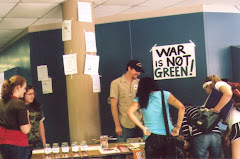
Our table at Austin HS


There was good interest from students at Austin HS last Friday, where we had a literature table with our usual materials, including the penny poll and the Peace Wheel of Fortune. Lots of students spun the wheel and could tell us about MLK -- and Flobots! John Lennon also was known by more students than at McCallum or Lanier, it seemed. A few knew about Gandhi and Cesar Chavez -- but quite a few only knew that their school stands on the street named for him. We hope we raised some awareness about Cesar Chavez and the other nonviolent freedom fighters on the wheel. See previous post for an information sheet about them.


The penny poll results indicated Health Care as number one priority once again. Environment and Education tied for second.

Monday, September 29, 2008

Our literature tables at Austin schools


Here's an update on our Nonmilitary Options activities so far this semester...

We've had literature tables at Travis HS, Lanier HS and McCallum HS and have dates planned for Austin HS, LBJ/LASA HS and Garza HS in the next two weeks.

We've done the penny poll and used the new Peace Wheel of Fortune at most of the schools so far this year.

The peace wheel generated lots of interest today at McCallum HS. Most students knew at least one or two of the peace sheroes and heroes on the wheel. Quite a few students knew about the hip-hop/rock band, Flobots (especially their hit song, Handlebars), which was great!
The idea of the wheel is that students spin it, the ticker stops on one of the peace sheroes/heroes, and if students can tell us something about that person, then they choose a prize.

Students liked the new "I think for myself!" buttons, which we used for peace wheel prizes along with Addicted to War books and the new "It's My Life!" books from the American Friends Service Committee.

We gave students who tried the peace wheel an info sheet to study up. Here it is. So, if you see us at your school, you've got an advantage!
Pursuing Justice, Peace and Freedom through Creative Nonviolence
Raul Salinas (1934 – 2008) was an Austin poet and educator who founded the Resistencia Bookstore on South First St. and shared his passion for art, writing and social justice through writing workshops in Austin schools.

Bernice Johnson Reagan is a composer, scholar, educator, performer and founder of the African American a cappella group, Sweet Honey in the Rock. As a college student, she was active in the Civil Rights Movement and was an original member of the SNCC (Student Nonviolent Coordinating Committee) Freedom Singers in 1962.

Martin Luther King, Jr. (1929 – 1968) is perhaps the best known of all US Civil Rights leaders. Following methods used by Gandhi and the freedom movement in India, King’s oratory, writings and personal example directed the movement in using nonviolent strategies such as mass marches, boycotts, sit-ins and direct negotiations in achieving equal rights.

John Lennon (1940 – 1980) was a member of the British rock band, The Beatles, and also had a successful solo career. He and his spouse, Yoko Ono were outspoken peace advocates who expressed their views through music and performance art.

Aung San Suu Kyi is a Nobel peace laureate and leader of the National League for Democracy in Burma who has lived under house arrest in Burma/Myanmar for some 14 years. Even though the government is ruled by a military junta, she is considered a leader by the Burmese people and continues to urge nonviolent resistance to the regime.

Cesar Chavez (1927 – 1993) led worker strikes, boycotts and marches for higher wages and better working conditions for agricultural workers in the US, including South Texas. He and Dolores Huerta co-founded the United Farm Workers, led the successful California grape boycott and helped organize other labor organizations in Texas and the Midwest.

Julia Butterfly Hill is a poet, speaker and environmental activist who lived for two years on a platform 18 stories high in a 1,000 year-old redwood tree in California as a protest against clear-cutting. Her book about that experience, The Legacy of Luna, was published in 2000.

Flobots is a rock/hip-hop band based in Denver. Their lyrics promote nonviolent social change. Their current release is Fight With Tools.

Mohandas Gandhi (1869 – 1948) was one of the most influential nonviolent activists in history. He helped lead India to independence from British Colonial Rule and his nonviolent methods inspired MLK and others in the US Civil Rights Movement.

Helen Keller (1880 –1968) was the first deafblind person to graduate from college. She learned to speak and became a world traveler and author who was outspoken in her advocacy for peace, women’s voting rights and labor rights.

Camilo Mejia is an Iraq war veteran who refused to return to combat because of moral objections to the war. His conscientious objector claim was denied by the US Army and he served a prison term. He is now president of the board of Iraq Veterans Against the War.

Go forth and wage peace!

Wednesday, September 24, 2008

What to do with the recruiter's climbing wall


Thanks to Seattle friends for sending this photo of Iraq Veterans Against the War taking it to the top on Sept. 23 at the University of Washington, where recruiters had set up a climbing wall.


Tuesday, September 23, 2008

Ben McKenzie compelling in new film, "Johnny Got His Gun"

Following on the previous blog post, this review of the new film based on the book by Dalton Trumbo is timely. The one-actor film premiered in Austin last night to a riveted audience. Here's an excellent account of the evening and the film. Don't miss it.


Johnny Got His Gun

By Alice Embree / The Rag Blog / September 23, 2008

“Johnny Got His Gun” opens in Austin September 26th at the Dobie Theatre. It is a starkly powerful film based on a 1939 antiwar novel by Dalton Trumbo. The sole actor is Austin native Ben McKenzie, best known for his role as a high school heartthrob in the television show, O.C.

See this movie. See it because Ben McKenzie is a fine actor. See it because Dalton Trumbo, one of the blacklisted Hollywood 10, writes a compelling story.

Let it stir memories of what a simply staged production can evoke. Buy a ticket because a portion of the ticket price supports the Fallen Patriot Fund for injured soldiers returning from Iraq and Afghanistan.

“Johnny Got His Gun” premiered at the Paramount in Austin Monday night. The audience included friends of Ben McKenzie and his family and peace activists along with young people brought there by Ben McKenzie’s star power. I wondered what the younger contingent thought when they silenced their cell phones to see a movie with no special effects and few laugh-lines. We have become so accustomed to multi-sensory experience, so wired to on-screen movement, that the sheer simplicity of this production is shocking.

Other characters were present only through the description of Joe Bonham, a quadruple amputee with catastrophic injuries to his face. The film traps you in a small space in the same way Joe Bonham is trapped.

“It evokes the isolation of major injury,” said a GI rights counselor after the film. Cindy Thomas, Army spouse, put it more simply to the director, “It reminded me of Walter Reed.”

I asked Ben McKenzie how he came to act in this movie. He said that the director, Rowan Joseph, approached him about the project. It was a powerful script and he thought he could reach a younger generation with its message.

Dalton Trumbo wrote his award-winning novel prompted by a news story about an American soldier hit by an artillery shell during World War I. As the soldier regains consciousness, he struggles to mark time and find ways to communicate. He asks to be put on display in the halls of Congress and in front of Parliaments as a living example of the true cost of war.

Dalton Trumbo, called before the House Un-American Activities Committee (HUAC) in 1947, was blacklisted and spent nearly a year in prison. He wrote under pseudonyms until the 60s. In 1971, as another war raged, he directed a screen adaptation of “Johnny Got His Gun,” starring Timothy Bottoms and Jason Robards.

We live in an era of sanitized war. Unlike the Vietnam era, most of us are shielded from the experience because there is no draft. There is virtually no television coverage of the war. Peace activists struggle to break through the ether. Hopefully, with Ben McKenzie as a draw, “Johnny Got His Gun” will bring the human cost of war to a new and wider audience.[For more about Johnny Got His Gun, go here.]