Thursday, February 9, 2012

Peace, art, scholarships (and other valentines) at Eastside Memorial HS

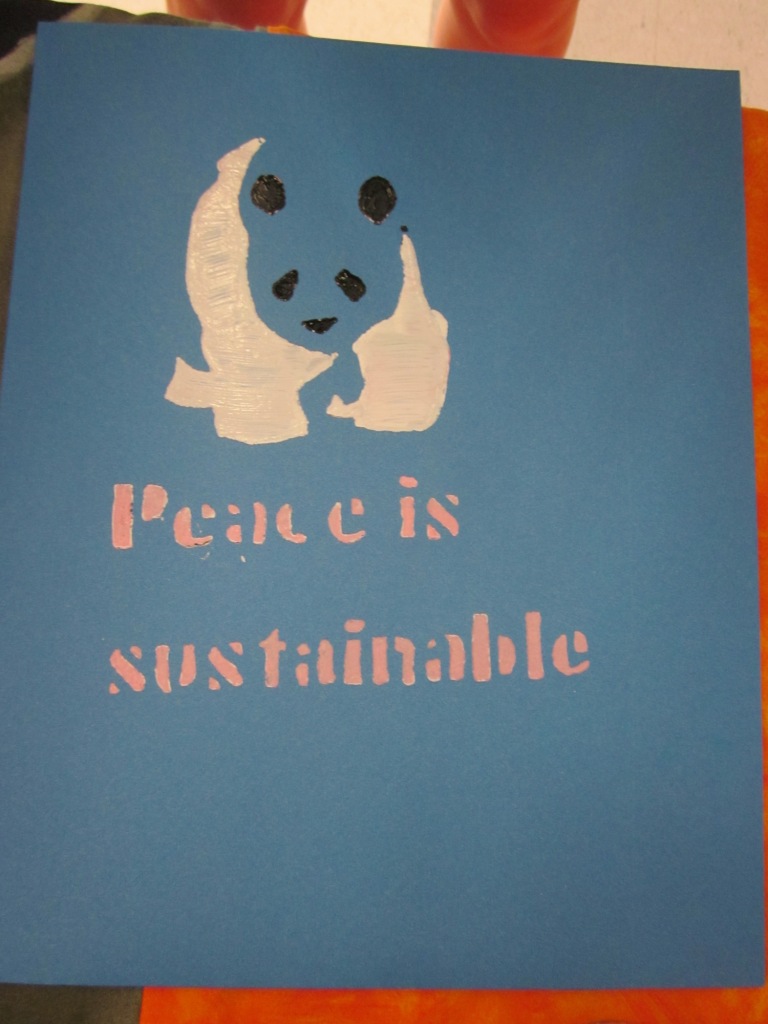
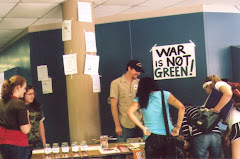
Tami and I had a great visit today at Eastside Memorial, both with the International School students and EM students during their lunch times.  We were set up in the hall foyer outside the cafeteria, and lots of students were interested in making valentines, stenciling folders and creating their own additional designs.  We had new info sheets listing some of the scholarships posted on the MALDEF site, especially for undocumented students (the list online is from last year, but most of the info should still apply.  Students should check about this year's deadline dates, though.)  We had application forms (one-page) for a local scholarship available for students in the Montopolis area, courtesy of one of our local supporters.  We learned more, also, about Eastside's resources for their international students and all who want to pursue college.  Undocumented students fill out paper TAFSA forms, and US citizens fill out FAFSA forms online, and the college/career room staff can help with that.  On February 4, Eastside students could attend a Financial Aid Saturday, co-sponsored by the Austin Chamber of Commerce, where help was provided in filling out FAFSA, TAFSA and scholarship application forms.

We added literature to the career room and library, next to where military brochures were stocked.

We checked out the great student art hanging outside the art room and admired the many hallway displays created by students.

Some photos from our day:


Students got the idea to start signing each other's folders...


 Items from our table:
 Tami at our table:


 In the International school, students come from many parts of the world...
 We restocked our literature in the school library, right next to the military brochures:

 Some examples of the remarkable student art portraits displayed outside the art room:


 Different times around the world...
 A hallway display:
 And this guy in the library... say wha???

Tuesday, January 24, 2012

New year tabling at Akins HS


We had our first literature table of the new year at Akins HS today.  Akins is either the first or second largest high school in our district, and because of the rainy day, most students stayed in the cafeteria to eat today, so it was packed.  We were directed to tables near one of the back walls where students waited in line for one of the food carts.  It was a good place to set up, with plenty of room for our stenciling project, peace wheel and literature.  I had added a new "Paz, Amor" stencil to our designs, since Valentines Day is coming up, and I brought colored paper in case students wanted to use that stencil to print valentines instead of folders.  I liked the way several students used the stencils to fashion their own messages.  For example, one woman made a birthday card for her Honduran friend that included a Honduran flag design.
We're stocked up with new literature from the War Resisters League:  a new flier written and designed by high school students, called, "Know Before You Go, Cause There's No Reset Button;"  a flier about the power of nonviolence; a pamphlet directed to women who are thinking of enlisting; and more of the Project YANO flier, "The military's not just a job -- it's 8 years of your life."

Wednesday, December 28, 2011

The universal thirst for knowledge - and peace

Some years ago, I met Ken Hannaford-Ricardi in Chicago when we were participating in a 10-day fast to try and bring more attention to the effects of the economic sanctions on the people of Iraq.  Ken has been active with Voices for Creative Nonviolence and has traveled to countries where the US has been at war in order to witness firsthand the effects of US policies on ordinary people.  Now, he is in Afghanistan and is writing about his experiences on Waging Nonviolence.  Here is his post from December 27 about meeting with young people in Kabul.

It’s early evening near Pole Sorkh (po-lay sork) Square in western Kabul. Although it’s barely 6:00, winter’s cold bare feet have already started their walk across our apartment. Ali, Abdulai, Roz Mohammend, and Faiz have joined Maya and me on the floor of a small room that later will double as a bedroom for a quiet evening of reading and studying. Like most of the others, I’ve cocooned myself in a thick quilt and I’ve begun reading Ha Jin’s novel of the Korean War, War Trash.


Not five minutes into the Prologue, I sensed Faiz edging his way over to me. His voice quiet, almost a whisper, slips out into the room; “Will you study with me?” Over the next fifteen minutes, we worked our way through three short lessons in a workbook written for first graders. Each consists of a simple, one page story followed by a series of questions based on the text. They are extraordinarily simple; they seem almost humiliating for a twenty year old young man. As we study, nineteen-year-old Roz Mohammed shyly carried his blanket and English language dictionary to our corner and settled in. Every so often, he’d shyly interrupt Faiz as he read and say, “Teacher, what does this word mean?”

Across the room, Maya and Ali worked on the meanings of basic words culled from a middle school dictionary. Ali studied intently, pronouncing each word carefully, as if it were an egg that might easily be broken. “Basket. Bully. Bundle,” he would say, repeating each word until he got it right.

A half hour after we began, still only a few sentences into Ha Jin’s prologue, I looked across at Maya and asked, “Where in America can you find anything like this? A cold room, nothing but quilts and a kettle for tea on the floor, and four boys asking us question after question about a language they’re trying to learn.” In truth, this type of thing happens all the time in our small apartment. The five young Afghan Youth Peace Volunteers who live here with their friend and mentor, Hakim, never go anywhere without a workbook or dictionary. After breakfast, one pulls a sheet of paper from his jacket pocket and begins to study. Waiting for a ride, another asks, “What does this mean?”

Across the hall from us live four university students. One is studying electricity; one aspires to be a pharmacist. Two days after our arrival, one of them, a young man named Said, knocked on our door and asked if one of us would like to help them learn English. Maya and I settled on meeting them in their apartment at 7 pm that night. The first class had three students; the second, five; now there are six. We work from copied pages and a white board. Each student actively participates.

Each of these young men, all symbols of the “new Afghanistan,” possesses a thirst that won’t be quenched. In our conversational practice, we talk of how they will shape their country in the years ahead. According to some figures, 68 percent of Afghanistan’s thirty one million people are under eighteen years old. No matter what the old guard wants to believe, the future of Afghanistan belongs to the young. We can only hope they won’t be co-opted by the temptations dangled before them by western “leadership.” We can only hope they’ll grab the reins of power and gallop off in a new direction, one of peace and reconciliation.

If the world you and I inhabit really wants to help these young people, and I doubt very much it does, it will do all it can to slake their thirst for knowledge. It will provide all the help they ask for, and nothing more. It will respect their intelligence and desire to find their own way. These students deserve our respect. They know, no matter what we say, they don’t have it now. It’s about time they do.   -- by Ken Hannaford-Ricardi
photo of Afghan Youth Peace Volunteers from Voices for Creative Nonviolence 

Thursday, December 8, 2011

Arts and letters at Bowie HS


Tami, George and I had a great day at Bowie HS today during their lunch sessions.  More students than at any school so far - about 50 - took us up on the offer to stencil their own file folders, and, as always, their creativity with the materials was wonderful: each one unique, even when using the same stencils.  Students also liked the Peace Wheel, and checked out the literature, including copies of Addicted to War.   Thanks to students and staff for taking part in our "make art, not war" theme, and for talking with us about issues regarding military enlistment, peace, Occupy, school classes and plans for the future.  We liked being situated in the hallway in front of the student banner shown in the photos above about healthy relationships, which relates to what we are talking about, too.